Best eCommerce Platforms for Growing Businesses in 2026
All online businesses should have a platform that can help them grow. With the continued growth of online shopping in 2026, customers will be looking for websites that are fast to load, compatible with all devices, and provide safe payment solutions. Picking an unsuitable platform can result in issues such as inefficiency, bad customer experience, and reduced sales. This is why most entrepreneurs ask, what is the best ecommerce platform? The truth is there is not one right answer since every business has distinct needs, budget, and goals. Choosing the Best eCommerce Platform can help you build a reliable online store and support your business as it grows.
Why Your eCommerce Platform Matters for Business Growth
- Supports Business Scalability
- Enhances Customer Experience
- Boosts Revenue
An expanding business requires an expandable system that is capable of managing increased traffic, items, and orders without compromising on efficiency. It is imperative that the Best Platform for Online Store be scalable.
Faster page loading speed, mobile optimization, and easy check-out processes contribute to the positive customer experience. Increased customer experience usually translates into greater satisfaction and loyalty.
Advanced platforms provide functionalities such as personalized recommendations and conversions. This helps businesses in increasing their customers and sales.
Key Features to Look for in an eCommerce Platform
- Easy Store Management
- Mobile Responsive Design
- SEO Friendly Architecture
- Multi-payment Gateway Support
- Inventory and Orders Management
- Marketing and Automation Tools
- AI Features and Personalization
- Security and Compliance
- Multilanguage and Multicurrency Support
- Third-party Integrations
Product management, price, and order management should be easy. An easy-to-use dashboard will save a lot of time.
Most people use their mobile phones when making purchases. It is important that your website works great on any device.
A SEO-Friendly eCommerce Platform means that your website can be easily found in search results because it is optimized properly.
Various options of payments can increase the convenience of your clients and make them trust you even more.
A decent set of inventory management tools is useful for tracking the stock of your goods and managing orders.
The built-in marketing tools will allow you to launch email campaigns, make various discounts, and engage your customers.
AI can analyze the behavior of customers and make personalized recommendations for them.
High-level protection is needed to ensure safety of all transactions on your website.
Such features help in attracting clients from other countries.
Shipping providers, CRM and marketing software should easily integrate with the platform.
Best eCommerce Platforms for Growing Businesses in 2026
- Shopify
- WooCommerce
- BigCommerce
- Adobe Commerce (Magento)
- Wix eCommerce
- Squarespace Commerce
- Salesforce Commerce Cloud
- OpenCart
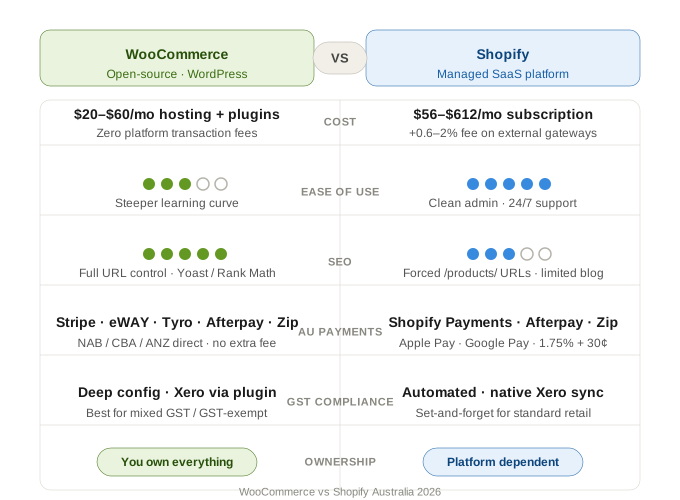
Shopify is ideal for startups and rapidly growing companies since it is easy to implement and maintain. Some of its advantages include secure hosting, responsive themes, and numerous functionalities that make it easy for businesses to get up and running within a shorter period. However, some functionalities will be paid apps, adding additional costs.
WooCommerce is an ideal platform for those businesses using the WordPress content management system. It allows complete customization of the store and works well with thousands of plugins. Though very flexible, the users have to take care of hosting, updates, and security of the website themselves.
BigCommerce is best for businesses that plan to grow their online stores without having to migrate to another platform in the future. Its advanced SEO tool, various payment methods, and features that support both B2B and B2C business models make BigCommerce an ideal choice. However, it might be a bit harder to learn than other platforms.
Adobe Commerce (Magento) is good for large companies that require customization and have advanced needs. Some of its advanced features include support for product catalogues, multiple stores, and large traffic volumes.
Wix eCommerce is suitable for those people who wish to create a simple website builder without having coding skills. Even though it is a user-friendly tool, it does not offer many advanced features compared to enterprise-level solutions. For those who wish to find the best platform for ecommerce website, it can be used for smaller websites.
Squarespace Commerce is an optimal choice for creative business which will create professional online store. This tool offers many templates, marketing tools and a comfortable editing process. Nevertheless, there are fewer customizing options than in other platforms.
Salesforce Commerce Cloud is developed for enterprises with high amount of sales and different customer channels. It offers AI-based personalization, automation and analytics tools. This platform is very powerful but requires more money and professional implementation.
OpenCart is an open source, inexpensive solution for business that requires flexibility and control over their online store. This platform allows creating many stores, integrating payment gateways and installing various extensions. Although there is no licensing fee, OpenCart requires additional technical skills from its users.
Which eCommerce Platform is Best for Your Business?
- Small Businesses
- Medium-Sized Businesses
- Enterprise Businesses
- B2B Companies
- D2C Brands
Small businesses generally demand an affordable and efficient platform. Shopify and Wix make a great fit since they are easy to set up, have user-friendly tools, and provide reliable technical support.
Medium-sized businesses usually demand more scalable solutions with advanced features. Shopify and BigCommerce can handle large traffic volumes and large catalog sizes.
Adobe Commerce is a great platform for large enterprises due to its high-level customization options, advanced security, and management of business processes.
A B2B company should choose a platform that has capabilities of handling bulk orders, custom pricing options, and business accounts. Such solutions are provided by BigCommerce.
A D2C brand requires a platform that offers a seamless shopping experience and marketing tools. Shopify is a great solution since it allows creating and scaling an online business.
Common Mistakes When Choosing an eCommerce Platform
- Choosing Based Only on Price
- Ignoring Scalability
- Ignoring the Possibility of Good SEO
- Not Checking Integration Options
- Ignoring Mobile Optimizations
- Forgetting Security Requirements
- Not Planning Future Growth
A cheap platform might be appealing to you now, but it will not necessarily provide the required functionality once your company grows.
Select the platform which will be able to work well under increased loads when you sell more products, have more users and traffic.
SEO capabilities will allow your store to rank well in search engines and attract organic traffic.
Make sure that it is possible to integrate your platform with payment systems, logistics, marketing and other software.
Because many people use their phones when looking for goods, you need a mobile optimized website.
secure platform ensures safety of client data and secure payments.
Think about the future, because selecting a scalable platform can save you a lot of time and money.
Future eCommerce Trends in 2026
- AI Shopping Assistants
- Voice Commerce
- Headless Commerce
- Social Commerce
- Predictive Analytics
AI-based assistants assist customers in finding products through personalized suggestions and immediate assistance.
The increasing number of customers who are searching for products using voice makes voice-commerce a necessity.
With headless commerce, companies can deliver fast and flexible experiences to customers on a variety of devices.
Social networks keep driving the revenue of companies because customers can both discover and buy products without switching from the app.
Companies can analyze customer data in order to understand their purchasing patterns and run marketing campaigns based on that information.
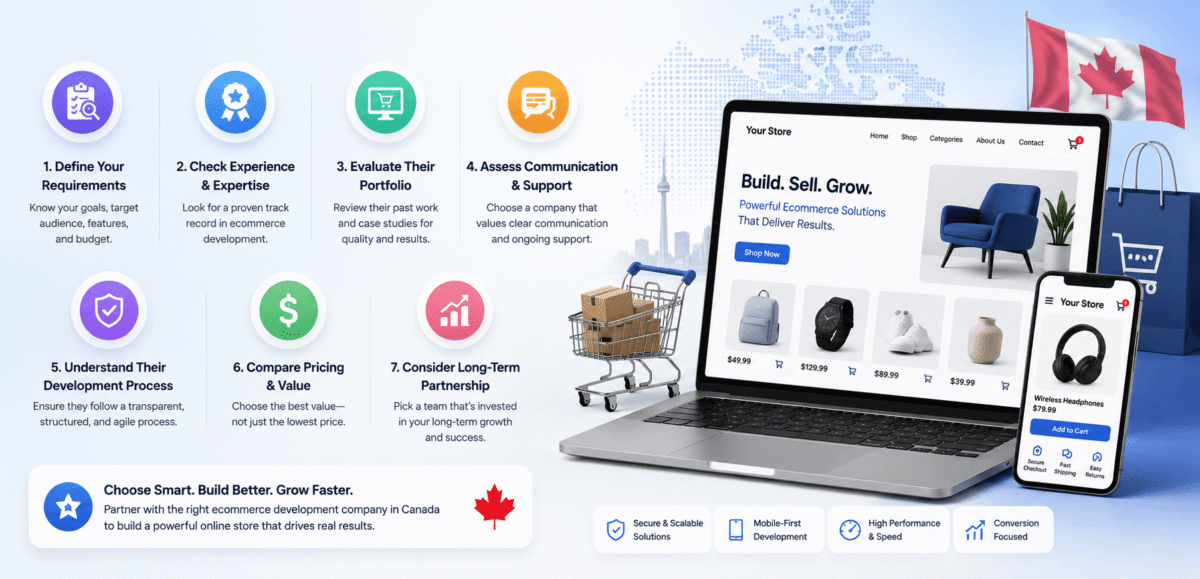
Why Work with an eCommerce Website Development Company?
- Development of Custom Online Store
- Consulting on Platform Choice
- Optimization of UI/UX
- SEO-Compatible Development
- Website Performance Optimization
- Integration of Third-Party Tools
- Maintenance and Support
Professional web developers create an online store that suits your business goals and meets the expectations of your customers.
Experts will help you to make comparisons between various platforms and select the one that suits your business needs and budget.
Good website design enhances its usability and leads to a better user experience.
Website developers use the principles of SEO to increase traffic to your site.
Well-performing websites load faster and offer better shopping experience for customers.
Professionals can integrate your website with such tools as payment services, shipping services, marketing software, etc.
Professional maintenance of your website will help it to perform better in the course of your business development.
Conclusion
Each online business will have specific requirements, thus no ecommerce platform that would suit all businesses. The Best eCommerce Platform can be defined as the platform that fits into your budget, meets your business objectives, and can grow along with you. When deciding which ecommerce platform to choose, pay attention not to its cost but to its features which are relevant for your business. Investing more time initially may help you to save money and avoid any difficulties in the future.