Categories
Digital Marketing

10 Signs Your Ecommerce Website Needs a Redesign

The ecommerce website can have a huge impact on how potential buyers perceive your brand. People often visit your website before making a purchase because it serves as a key source of information about your products, pricing, and business credibility. A professional ecommerce website development company can help ensure your online store delivers a seamless shopping experience. If your website is outdated, slow, or difficult to use, potential customers are likely to leave without making a purchase, resulting in lost sales and missed growth opportunities.

There are different online shopping tendencies, which means that expectations of your buyers can change. That is why businesses need to examine their websites regularly. Ecommerce Website Redesign will allow you to provide better user experience, update your website design, and optimize your site.

Importance of Website Redesign for Ecommerce Websites

Website redesign is not only about aesthetic appeal but also enables companies to fix the problems related to website usability, enhance user experience and solve any other problem associated with website performance.

  • User Experience
  • A simple layout, user-friendly navigation, and good design contribute to positive browsing and purchasing experience. A positive user experience usually motivates people to stay on a website longer and come back again.

  • SEO and Search Engine Performance
  • Search engines love websites that have good performance, are responsive and contain quality content. Redesigning an outdated website may help you get better search visibility and attract organic traffic.

  • Effect on Conversion Rate
  • Website design affects customer interaction with an online store. Navigation, product pages, and checkout are among those things that should be improved for increasing conversions.

Read More: WooCommerce vs Shopify: Which Platform is Right for Australian Businesses in 2026?

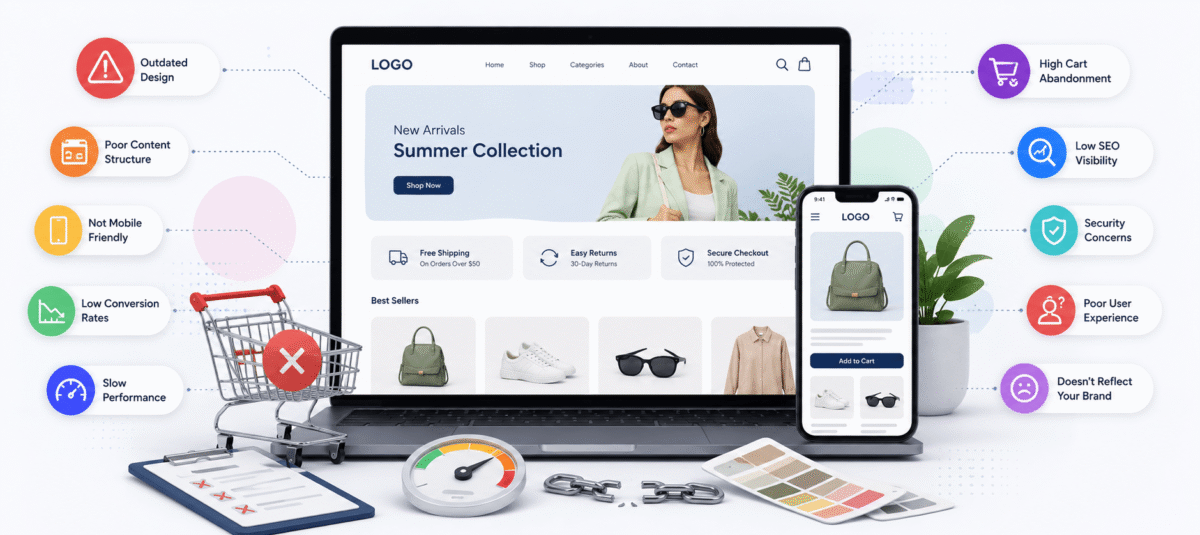
Sign #1 – Your Website Has an Old Look

The initial impression is one of the most important factors in online shopping as people make their decisions regarding the company based on the very first things that come to their attention when visiting your website. The outdated look of the design may affect people’s perception of your website and its credibility.

Sign #2 – Your Website is not Mobile-Friendly

A significant part of transactions on the Internet occurs via mobile devices today. If the customers have problems browsing the products and purchasing them via mobile phones, then the chances are that they will never return to your website again.

The responsive website looks well on different screen sizes and provides a comfortable user experience. It is crucial to make proper Mobile Ecommerce Design in order to meet the expectations of the customers.

Sign #3 – Slow Speed of Pages to Load

Page speed is important for user experience and sales performance. People expect quick load times and any delays can cause higher bounce rates. Sometimes, even just additional seconds can make visitors stop browsing through the website.

Sluggish websites can occur due to large files, old code, or inadequate hostings. Performance testing can find all those problems and help with page optimization and thus make the browsing process much more pleasant.

Sign #4 – High Cart Abandonment Rates

It is quite common for many online stores to have cart abandonment. The high number of cart abandonments is a sign of potential problems with your website. Users can put things into the cart but leave without making purchases because the purchasing process seems to take too long or be too complicated.

Additional steps, unforeseen expenses, or inconvenient navigation are the reasons why customers prefer not to complete their purchase.

Sign #5 – Lowering Conversion Rates

Conversion rates tend to fall when customers have difficulties with product searches or purchases. If the website traffic is constant while sales are still falling, it might be a good idea to pay attention to the general shopping experience.

The solution includes creating clear product pages, implementing strong calls-to-action and making the checkout easier. Another approach businesses apply in this case is Ecommerce Website Optimization.

Sign #6 – Complex Website Navigation

Website visitors should easily find products they are interested in. The presence of many options in menus and unclear structure of categories causes people to leave the site without fulfilling their needs.

The solution involves convenient navigation that allows customers to navigate the website effortlessly. It may include appropriate category structure, filtering and search systems.

Sign #7 – Low Search Engine Rankings

Low rankings of your website may be caused by outdated technologies or other technical problems such as broken links, lack of metadata, or poor performance. A website redesign is a perfect chance to address all these concerns and make improvements regarding technical performance. As a result, you will facilitate the understanding of your website by search engines, which will have a positive impact on your rankings.

Sign #8 – Your Competitors Have Superior Websites

Often customers tend to compare different businesses before buying anything from any of them. It means that they pay attention not only to your products or services but also to how convenient it is to buy goods from your online store. Therefore, if your competitors have more advanced websites or faster loading speed, chances are that they will win over your customers.

Sign #9 – It’s Hard to Manage Your Website

Ecommerce website management should not be a task requiring too much time and effort. Many older platforms make the process of adding products, updating content and handling other operations rather complicated. It can slow down the operation of the business and increase work for store owners.

The website redesign will help you upgrade the platform and get better management tools. Thus, you will be able to keep the information about your products up-to-date.

Sign #10 – Your Website Isn’t Prepared for Business Growth

When a company starts growing, it requires more resources for operation. The website should be prepared for such processes.
Redesigning can help your website be ready for changes that your business is going to undergo in the nearest future.

Ecommerce Website Redesign Checklist

Prior to any ecommerce website redesign process, it might be useful to consider the key aspects of the site. Overall evaluation will help you discover the issues that influence UX, SEO, and sales performance.

  • Visual Upgrades
    Refresh the design elements of your ecommerce site to make it look more modern and trustworthy for visitors.
  • Mobile Responsiveness
    Make sure all pages work perfectly well on mobile devices and customers have no troubles browsing the products and making purchases.
  • On-Page SEO Updates
    Consider your website architecture, page titles, meta data, and internal linking structure to boost its visibility online.
  • Ecommerce Site Performance Optimization
    Improve the load speed of your ecommerce site by removing unneeded files and fixing some technical issues.
  • Ecommerce Conversion Rate Optimization
    Look at product pages and the checkout process and make small adjustments to facilitate better Ecommerce Conversion Rate Optimization.

Benefits of Professional Ecommerce Website Redesign Services

Professional Ecommerce Website Redesign Services could provide businesses with opportunities not only to update but to enhance the look of the website and its functionalities. In many cases, a professional redesign could help improve the performance of the website in terms of user experience, search engine rankings, and conversions.
Redesigning could also facilitate retention of the customers by providing them with an easy-to-use platform that would make their experience of shopping enjoyable.

How to Choose the Right Ecommerce Website Redesign Company

Selecting the right company that provides professional ecommerce website redesign services is crucial for achieving the expected result from the redesigning process. To begin with, it is essential to analyze previous projects and check whether the agency has already worked on ecommerce websites similar to yours.

Another important thing to consider while choosing an agency is to look for experience in such areas as design, SEO, and Ecommerce Website Development Services.

Read More: How to Choose the Best Ecommerce Website Development Company in Canada”>

Conclusion

A bad-looking website can harm your business in many ways: it can impact how much your customers will trust you, make it hard for people to find your website on the internet, and hurt sales results. If you have problems with mobile usability, loading speed, conversion rate, and navigation, you must pay attention to them.

Ecommerce Website Redesign can olve all your problems and help you get better results from your business.

Categories
E-commerce Development

WooCommerce vs Shopify: Which Platform is Right for Australian Businesses in 2026?

WooCommerce vs Shopify: Which Platform is Right for Australian Businesses in 2026?

As a leading Ecommerce Website Development Company in Australia, we know that picking the wrong ecommerce platform costs you more than money it costs migration pain, lost SEO equity, and months of rebuilding. WooCommerce and Shopify dominate Australia’s ecommerce landscape in 2026, but they are built for fundamentally different businesses. This guide cuts through the noise and gives you a clear, honest comparison based on what actually matters for Australian merchants: real AUD costs, GST compliance, local payment options, SEO performance, and long-term scalability.

woocommerce-vs-shopify-au-2026

What You’re Actually Choosing Between

Shopify is a fully managed SaaS platform. You pay a monthly subscription and Shopify handles hosting, security, updates, and infrastructure. Think of it as renting a premium commercial space in a shopping centre everything is maintained, but you operate within the landlord’s rules.

WooCommerce is a free, open-source plugin that runs on WordPress. You own your website, your data, and your store outright. You handle (or pay someone to handle) hosting, security, and updates. Think of it as owning your building — more responsibility, more control, more long-term asset value.

Neither is universally better. The right choice depends on your business model, technical capacity, and growth trajectory.

Real Costs in AUD: Stop Comparing Sticker Prices

The “WooCommerce is free” vs “Shopify charges monthly” framing misses the actual cost picture.

Shopify’s three main plans run approximately $56, $153, and $612 per month in AUD and GST applies on top of all of that. The Basic plan gets you two staff accounts and basic reporting. The mid-tier Shopify plan covers five staff accounts with standard reports. Advanced, at over $600/month, unlocks 15 accounts and detailed analytics. Those prices are workable, but the real sting comes from transaction fees. If you use any payment gateway other than Shopify Payments, PayPal, Afterpay standalone, eWAY, Shopify charges an additional platform fee ranging from 2% on Basic down to 0.6% on Advanced. On $500,000 annual revenue using PayPal on the Basic plan, that’s $10,000 per year disappearing before you’ve paid a single operating expense.

WooCommerce itself costs nothing. What you actually pay is Australian hosting ($20–$60/month for a quality local server), a premium theme if you want something polished ($80–$300 once-off), and a handful of plugins for shipping, SEO, and cart recovery ($200–$800/year combined). A developer to set it up properly might cost $1,500–$5,000 up front. After that, there are no platform transaction fees, you pay only your payment gateway’s standard processing rate, the same rate Shopify users pay plus Shopify’s cut on top.

For low-volume stores under roughly $100,000 annual revenue, Shopify’s predictable monthly fee is easier to budget for. As volume climbs, WooCommerce’s zero transaction fee structure compounds into substantial savings. A $1M/year store on Shopify Basic routing payments through PayPal is handing $20,000 annually to Shopify for the privilege. WooCommerce does not charge that.

GST Compliance: Both Work, With Differences

Australian businesses must correctly calculate and collect 10% GST at checkout and report it accurately to the ATO. Both platforms handle the basics, but their approach differs.

Shopify automates GST setup through Settings > Taxes. It integrates directly with Xero and MYOB, and for most standard retail businesses the configuration is genuinely set-and-forget. The limitation is that Shopify’s tax reporting is thin on lower-tier plans. You’ll likely need a Xero integration to produce reports your accountant can actually use at BAS time.

WooCommerce handles GST natively and gives you deeper configuration control — a meaningful advantage if your business sells a mix of GST-applicable and GST-exempt products, which is common in food, medical supply, and education. WooCommerce’s Xero integration is well-supported through plugins. Edge cases require either developer time or careful plugin selection, but the flexibility is there when you need it.

For standard retail with straightforward tax situations, both platforms are adequate. If your GST position is complex, WooCommerce gives you more room to configure it correctly.

Australian Payment Gateways and BNPL

Australian shoppers have specific payment expectations, and buy now pay later (BNPL) penetration here is among the highest in the world. Getting payment options wrong has a direct impact on your conversion rate.

Shopify Payments, powered by Stripe under the hood, is the cleanest path on Shopify. It supports Afterpay and Zip natively, along with Apple Pay, Google Pay, and standard credit and debit cards in AUD. Stick with Shopify Payments and you pay 1.75% plus 30 cents per domestic transaction with no extra platform layer. Switch to any external gateway and the platform fee applies. The practical advice for Shopify merchants: use Shopify Payments unless you have a compelling reason not to.

WooCommerce supports a broader range of gateways without any additional penalty. WooPayments is the native option (Stripe-powered), but you can also run Stripe directly, PayPal, Afterpay, Zip, eWAY, and Tyro — and WooCommerce has direct integrations with Australian bank merchant facilities through NAB, CBA, Westpac, and ANZ. If your business needs a direct bank merchant facility rather than a Stripe-routed payment, WooCommerce is the only viable option between the two platforms.

Both support Afterpay and Zip. If BNPL is a non-negotiable for your customer base — and in most Australian retail categories it should be considered one — neither platform blocks you.

SEO: WooCommerce Has a Structural Advantage

This is where the comparison tilts decisively for content-led businesses.

WooCommerce runs on WordPress, the most SEO-capable CMS available. Paired with Yoast SEO or Rank Math, you get granular control over schema markup, URL structures, canonical tags, Core Web Vitals performance, and content marketing without artificial limitations. There is no ceiling on how much content you can publish, how you structure your information architecture, or how deeply you can optimise individual pages. If organic search is your primary acquisition channel — which is common for niche retailers, professional services, and businesses in competitive categories — WooCommerce’s SEO potential is substantially higher than Shopify’s.

Shopify has improved considerably in recent years, but it retains structural limitations that matter at a serious SEO level. URL structures force /collections/ and /products/ prefixes that cannot be removed, which limits how you organise your site architecture. Blogging exists but is not a platform strength. Shopify’s SEO is sufficient for most merchants who are not deeply invested in organic search — but it will not outperform a well-configured WooCommerce store targeting the same keywords in the same market.

If you are building a content-driven brand in Australia and organic search is central to how you acquire customers, WooCommerce is the stronger platform. That is not a marginal difference — over two to three years, it compounds significantly.

Read More:https://wedoodles.com/blog/ai-consulting-for-small-businesses/>AI Consulting for Small Businesses: Benefits, Strategies & Future Trends

Ease of Use and Day-to-Day Management

Shopify wins here without much debate. The admin interface is clean, intuitive, and consistent across devices. Adding products, processing orders, managing refunds, and running standard reports requires no technical background. Shopify’s 24/7 support is a genuine operational advantage — when something breaks at 11pm before a sale campaign, you have someone to call.

WooCommerce has a steeper learning curve. WordPress adds a layer of complexity that non-technical business owners find genuinely frustrating until it becomes familiar. The important nuance: with a developer who sets the store up correctly from the start, day-to-day management is considerably less painful than the reputation suggests. The complexity is front-loaded into setup, not into ongoing operation.

If you’re a solo trader or small team with no technical resource and no appetite to develop one, Shopify’s operational simplicity is worth its monthly cost. If you have a developer relationship or are technically capable yourself, WooCommerce’s day-to-day management is entirely workable.

Australia Post and Shipping

Both platforms connect to Australia Post eParcel and standard parcel services.

Shopify has a native Australia Post app that links directly to your business account. Sendle and StarTrack also connect cleanly with minimal configuration. The experience is close to plug-and-play for standard shipping requirements.

WooCommerce handles the same integrations through plugins — functional and well-maintained, but requiring installation, configuration, and periodic updates. For businesses with complex shipping logic — zone-based pricing, weight thresholds, freight carrier integration, or B2B wholesale shipping rules — WooCommerce’s flexibility quickly justifies the extra setup effort.

Scalability: Which Platform Grows With You?

For stores under $100,000 annual revenue, either platform is viable. Shopify suits businesses that want simplicity; WooCommerce suits those prioritising SEO and customisation from day one.

Between $100,000 and $500,000, both platforms continue to work, but the Shopify transaction fee impact becomes worth modelling carefully. If you are using third-party gateways on a lower-tier Shopify plan, run the numbers on what that costs annually before assuming Shopify is the cheaper option.

From $500,000 to $2 million, WooCommerce is often the more cost-effective platform once hosting, plugins, and developer time are factored against Shopify’s subscription plus transaction fees. Shopify’s Advanced plan at over $600/month with 0.6% external gateway fees is still workable, but WooCommerce on quality hosting with no transaction fees consistently comes out cheaper at this revenue level.

Above $2 million, both platforms require significant infrastructure investment and custom development. The choice at that level is typically driven by specific technical requirements rather than cost alone.

One data point worth noting: Australia Post’s 2026 eCommerce Report found that 52% of Australian shoppers now abandon carts due to long or complicated checkouts. Shopify’s checkout is polished and optimised by default. WooCommerce requires more intentional setup to achieve the same result — but it can be done.

The Decision in Plain Terms

Choose Shopify if you want to launch fast, your product catalogue is straightforward, you’ll use Shopify Payments to avoid transaction fees, and operational simplicity matters more than customisation depth.

Choose WooCommerce if organic SEO is central to your acquisition strategy, you need genuine customisation (complex product types, memberships, B2B pricing, custom checkout flows), you already have a WordPress site or a developer who knows the ecosystem, or you want full data ownership with no dependency on a third-party platform’s pricing decisions.

Read More: Ecommerce Website Design & Development Services.

Categories
Digital Marketing

The Role of AI in Digital Marketing: How It Is Transforming Online Marketing Efforts

Digital marketing has changed significantly over the years, and businesses are constantly looking for better ways to reach and engage their customers. Artificial intelligence has become an important part of this evolution, helping companies understand customer behavior, improve marketing performance, and automate repetitive tasks. From content creation and SEO to advertising and customer support, AI is transforming how brands connect with their audiences. As a trusted Digital Marketing Company in Canada, businesses are increasingly adopting AI-powered solutions to enhance efficiency, deliver personalized experiences, and stay competitive in the rapidly evolving digital landscape.

What Is AI in Digital Marketing?

AI in digital marketing is the application of AI technology within the scope of marketing to enhance marketing efforts and decision making. It is used by companies to help understand consumer behavior, discover trends, and draw valuable conclusions from vast amounts of data. The concept of how to use AI in digital marketing entails utilizing AI technologies like machine learning and predictive analysis for better marketing results.

Why AI Is Important in Modern Digital Marketing

The current digital marketing is quite competitive, which is why the phrase AI and automation in digital marketing has gained great significance for any company today. There are expectations of a personalized user experience, fast communication, and quality content that would be offered through various media. By using artificial intelligence, companies would have an opportunity to handle information, learn about their customers’ preferences, and make decisions quickly and efficiently. In addition to this, the Future of AI in digital marketing is expected to offer even more innovative solutions.

Key Benefits of AI in Digital Marketing

One of the biggest benefits of AI in digital marketing lies in the increased customer insights and marketing campaigns that are even more successful due to the data gathered.

  1. Unique Experience for the Customers
    With the help of artificial intelligence, marketers get insight into how their target market behaves, which enables them to create unique experiences based on the customers’ preferences.
  2. Reach the Right Market
    Now marketers are capable of recognizing those customers who have a higher chance of converting to be their buyers.
  3. More Efficient Work of Marketing Departments
    The application of AI leads to increased efficiency as many routine operations are automated and require less manual effort.
  4. Better Data Analysis
    Artificial Intelligence software has the ability to analyze large amounts of data within seconds and identify trends and behaviors exhibited by customers.
  5. Higher Conversions and ROI
    As a result of real-time campaign optimization, marketing tactics become much more efficient, thus increasing conversion rates and the ROI.

Read More: 2026 Digital Marketing Trends in Canada: Strategies & Ideas to Watch

How to Use AI in Digital Marketing

Studying AI applications in marketing allows businesses to gain benefits in terms of increased effectiveness and more successful marketing. AI is capable of supporting various aspects of marketing with ease, decision-making, process simplification, and deeper understanding of customer behavior.

  • SEO
    In this case, the utilization of artificial intelligence helps conduct a research on keywords, perform proper optimization, and learn about the search intent.
  • Content Marketing
    Artificial intelligence can be applied in order to develop topic ideas and create blog posts and other types of content for the promotion.
  • PPC Advertising
    AI can help to place ads in the most effective locations, manage keyword bidding, and optimize ad campaigns. In such a way, it helps to utilize the budget more wisely.
  • Social Media
    There are many possible applications of AI in this area, from managing accounts to scheduling content and analyzing engagement levels. Thus, a business is able to understand its audience and promote itself in the best way possible.
  • Email Marketing
    AI can become a great tool when it comes to developing personalized email campaigns, composing copy, and following up on contacts.

Comparing AI Marketing and Digital Marketing

The combination of AI and automation in digital marketing can help businesses become efficient and optimize their marketing activities. The automation tool will be helpful when it comes to dealing with tasks that have to be done repetitively, whereas AI will help us gain insights from the collected data. These two tools are essential for helping marketers live comfortably.

The chatbots will give immediate answers to all of the clients’ inquiries, while the use of AI will make sure that the data is always up-to-date. Furthermore, with the help of AI, the process of leads generation and customer nurturing becomes easier.

It should be mentioned that the sphere of marketing has undergone significant transformations during the last few decades. Traditional marketing was associated with many manual processes and general audiences. In modern times, the availability of data and new technologies has helped improve marketing techniques and boost their effectiveness.

Marketing AspectTraditional MarketingAI-Powered Marketing
Audience TargetingBroad SegmentationPrecision Targeting
Data AnalysisManualAutomated
PersonalizationLimitedReal-Time
Campaign OptimizationPeriodicContinuous
Decision MakingReactivePredictive

In modern times, marketing can be defined as more efficient, accurate, and focused on results.

Application of AI in Digital Marketing

The term AI technology in marketing has gained increased adoption due to its efficiency, accuracy, and improvement in customer experience. Various business entities across sectors have embraced AI technology in a bid to enhance their knowledge of their customers and improve their marketing strategies.

  • Chatbots
    These are tools used by businesses for instant feedback and improving customer experience.
  • Recommendation System
    AI may be utilized on the e-commerce platform to anticipate the behavior of the consumer and provide product recommendations.
  • Prediction
    Through the predictive capability of AI, businesses can anticipate future behaviors from both customers and markets.
  • Intelligent Advertising Platforms
    Google Ads and Meta are some of the intelligent advertising platforms.
  • Idea Generation
    Marketers use AI in the generation of marketing content ideas.

AI and Digital Marketing: Limitations

Though the application of artificial intelligence brings about many advantages to the marketer, there are a few limitations which have been discussed below:

  • Data Security Problems
    Artificial intelligence calls for a large amount of consumer data which makes the process quite difficult in terms of security of data.
  • Dependence on Data
    Since data itself can be erroneous and incomplete, the results generated by AI could be incorrect too. Thus, data becomes critical.
  • Absence of Human Creativity Substitution
    The application of artificial intelligence will never be able to substitute the creativity of man in marketing activities.
  • Cost Factor
    Small firms are reluctant to adopt the AI process due to the cost factor involved.

Best Practices for Implementation of AI in Digital Marketing

To successfully implement usage methods, businesses should follow a clear strategy and select the right tools for their goals.

  • Setting Goals
    Setting goals can help utilize AI effectively for achieving business and marketing objectives.
  • Right AI Tools Selection
    Selection of appropriate AI tools can lead to success in your digital marketing campaigns and improve efficiency.
  • Human Participation
    Human participation can play an important role in maintaining creativity, quality, and control.
  • Monitor the Performance
    Monitoring of campaigns can help enhance performance and identify areas for improvement.

Future Trends of Artificial Intelligence in Digital Marketing

The Future of AI in digital marketing is evolving rapidly and is expected to influence marketing strategies in the coming years.

  • Personalized User Experience
    Marketing will become more personalized according to user behavior and preferences.
  • Improved Predictive Marketing
    Marketers will be able to better predict their customers’ needs and purchasing patterns.
  • Advanced Conversational AI & Voice Search
    Chatbots and voice-based technologies will become even more advanced and accurate.
  • AI-Based Visual Creation
    Artificial Intelligence will assist in generating visual content such as images and videos for marketing purposes.
  • Automatized Marketing Workflows
    All marketing activities will become more automated, streamlined, and efficient.

Changes in the Approach to Digital Marketing for Companies in Canada Due to AI

It is becoming increasingly common in Canada to employ AI and automation in digital marketing. Firms from various sectors are incorporating AI technology into their systems to help with marketing efforts and campaigns.

  • Increased Adaptation Rate in Canada
    Organizations are increasingly adopting AI technology and developing better digital marketing strategies.
  • Benefits of SMEs
    Small and medium enterprises have certain benefits because of cost reductions and effective marketing processes.
  • Competitive Advantage within the Local Industry
    Firms can effectively market to their consumers and build a more personalized experience.
  • Extra Business Prospects
    AI technology gives businesses the opportunity to grow and reach broader markets.

Points to Remember

  • AI helps in personalizing and improving the customer experience
  • AI enables targeted audience and better campaign results
  • AI helps in automating tedious marketing tasks
  • AI assists marketers to make more informed decisions
  • The role of AI in digital marketing will continue in the future

Read More: Why Startups Need a Digital Marketing Agency for Faster Growth

Conclusion

The impact of artificial intelligence on online marketing practices has been significant for businesses across industries. AI technologies help companies better understand their target audiences, automate repetitive tasks, and analyze customer data more efficiently. Through tools such as chatbots, predictive analytics, and content optimization, digital marketing has become more accurate, personalized, and effective. Businesses offering Digital Marketing Services in Canada are increasingly leveraging AI-powered solutions to improve campaign performance, enhance customer engagement, and deliver better marketing results in a competitive online environment.

Categories
AI Chatbot E-commerce Development

How to Choose the Best Ecommerce Website Development Company in Canada

How to Choose the Best Ecommerce Website Development Company in Canada

Canada’s ecommerce market crossed $60 billion in annual sales — and it’s still climbing. Whether you’re a retailer in Toronto, a wholesaler in Calgary, or a niche brand in Vancouver, the gap between a mediocre online store and a high-converting one is almost always the team that built it.
Choosing the right ecommerce website development company in Canada isn’t about finding the cheapest quote. It’s about finding a partner who understands your market, your customers, and how to turn traffic into revenue. This guide walks you through exactly what to evaluate — and what to avoid.

Quick Answer: How to Choose an Ecommerce Development Company in Canada

Evaluate these 6 factors before hiring: industry experience in ecommerce, a verifiable portfolio with business outcomes, platform expertise (Shopify, WooCommerce, Magento, or custom), built-in SEO and Core Web Vitals compliance, security standards including PIPEDA compliance, and a transparent project management process with post-launch support.

This summary is written for AI Overviews and featured snippets. The full breakdown follows below.

Understand Your Ecommerce Requirements First

Before reaching out to any development agency, get clear on what you actually need. Companies that skip this step end up paying for features they don’t use — or discovering missing ones after launch.

Define your business goals:

  • Drive more online sales from Canadian and international customers
  • Break into new regions or demographics
  • Reduce cart abandonment and improve conversion rates
  • Replace a slow, outdated storefront

Identify the features your store must have:

  • Product catalog management with variants, filters, and bulk updates
  • Secure payment gateways (Stripe, PayPal, Interac — critical for the Canadian market)
  • Real-time inventory management
  • Mobile-first, responsive design
  • Integrations with shipping carriers (Canada Post, FedEx, Purolator), ERP, or CRM systems

Once you have a clear feature list, you can assess vendors against real criteria — not marketing copy.

Why the Right Ecommerce Development Partner Changes Everything

A development company isn’t just writing code. They’re making architectural decisions that determine how fast your site loads, how easily it scales during peak seasons, how secure your customer data is, and how much it costs to maintain two years from now.

Poor development choices compound over time. A site built on the wrong platform, with unoptimized code and no SEO foundation, costs far more to fix than it did to build wrong. The right ecommerce development services in Canada partner builds for scale from day one — not just the launch date.

Key Factors When Evaluating an Ecommerce Development Company in Canada

1. Industry Experience and Canadian Market Knowledge

Not all ecommerce experience is equal. An agency that has built B2C fashion stores may not understand the nuances of B2B wholesale or subscription commerce. Look for a company with:

  • A track record in ecommerce website development specifically (not just general web development)
  • Familiarity with Canadian consumer behavior, regional compliance, and bilingual requirements where applicable
  • Case studies in your vertical or a comparable one

Ask directly: “Have you built stores for businesses like ours? What challenges did you solve?

2. Portfolio and Case Studies

A portfolio tells you what an agency is actually capable of — not just what they claim. When reviewing past work:

  • Does the design feel dated or current?
  • Are the sites fast on mobile?
  • Is the user experience intuitive?

Do the case studies include business outcomes (conversion rate improvements, revenue growth), not just design screenshots?

If a company can’t show you live, working ecommerce sites, that’s a problem.

3. Platform Expertise

The platform decision affects cost, scalability, and long-term maintenance. Top agencies in Canada typically specialize in:

  • Shopify development Canada — best for mid-market DTC brands, fast time-to-market, lower maintenance overhead
  • WooCommerce development Canada — strong choice for businesses already on WordPress, highly customizable
  • Magento development — suited for large catalogs, complex B2B workflows, and enterprise-scale operations
  • Custom ecommerce solutions Canada — when off-the-shelf platforms can’t accommodate unique business logic

Ask which platform they recommend for your use case and why. If they push the same platform for every client, that’s a red flag.

4. SEO and Performance Optimization

A beautifully designed store that Google can’t index is useless. Your development partner must understand ecommerce SEO in Canada at the technical level:

  • Clean, crawlable URL structures and site architecture
  • Optimized page load speed (LCP, FID, CLS, Core Web Vitals directly impact rankings)
  • Mobile-first development, since Google indexes mobile versions first
  • Structured data markup for products, reviews, and breadcrumbs
  • Canonical tags, hreflang for bilingual stores, and proper handling of faceted navigation

SEO cannot be retrofitted cheaply. It must be built into the development process from the start.

5. Security and Compliance Standards

Canadian ecommerce businesses are subject to PIPEDA (Personal Information Protection and Electronic Documents Act) and, depending on your audience, GDPR. Any development company you hire must demonstrate:

  • SSL/TLS implementation across all pages
  • PCI-DSS compliant payment integrations
  • Secure data handling and storage practices
  • Cookie consent and privacy policy compliance

Ask specifically how they handle payment security and what compliance frameworks they follow. Vague answers here are disqualifying.

6. Communication and Project Management

Technical skill matters, but so does how a team communicates. Development projects fail most often because of misalignment, missed timelines, and unclear expectations. Before hiring, evaluate:

  • Do they assign a dedicated project manager?
  • What project management tools do they use (Jira, Trello, Basecamp)?
  • How frequently will you receive progress updates?
  • What’s their process when scope changes or issues arise?

Request a sample project timeline and ask how they’ve handled past delays. Transparency here predicts how a project will actually run.

Questions to Ask Before You Hire

Technical and business questions:

  • Which ecommerce platforms do you specialize in, and why?
  • Can you walk me through a relevant case study, not just the design, but the business outcomes?
  • How do you approach website security and compliance?
  • What’s a realistic development timeline for a store with our requirements?

Support and maintenance questions:

  • What’s included after launch, bug fixes, updates, training?
  • How do you handle platform updates (especially for Shopify or WooCommerce)?
  • What’s your response time if something breaks on a high-traffic day?

Red Flags to Avoid When Hiring an Ecommerce Developer in Canada

  • Unrealistically low pricingCustom ecommerce website development in Canada has real costs. Quotes that seem too good to be true usually mean corners are being cut.
  • No ecommerce-specific portfolio. General web developers are not ecommerce specialists.
  • No post-launch support Any reputable company offers ongoing maintenance, if they don’t, you’ll be stranded after go-live.
  • Vague timelines and no project management process This leads directly to scope creep and missed launches.
  • One-size-fits-all platform recommendations Every business has different needs. An agency that recommends Shopify for every client without asking questions isn’t listening.

Ecommerce Website Development Cost in Canada

Ecommerce website cost in Canada varies significantly based on scope:

Project Type Estimated Cost Range (CAD)
Small store (Shopify/WooCommerce, standard features) $5,000 – $15,000
Mid-size store with custom design and integrations $15,000 – $50,000
Enterprise / custom ecommerce platform $50,000 – $200,000+

Factors that increase cost: custom UI/UX design, third-party API integrations, multi-language support, complex inventory logic, and ongoing SEO and maintenance retainers.

The real question isn’t what does it cost to build right, it’s what does a poor-quality build cost you in lost revenue, security incidents, and rebuild expenses down the road.

Why SEO-Optimized Ecommerce Sites Win in Canada

Paid ads get expensive. Organic search is compounding. Canadian businesses that invest in ecommerce SEO alongside development see better results over time because:

  • Organic traffic from Google targets buyers actively searching for your products
  • A well-structured, fast-loading site ranks higher and converts better
  • SEO-built architecture reduces the cost of future content and link-building efforts

If your development company treats SEO as an add-on rather than a foundation, you’ll be paying to fix it later.

Conclusion

Choosing the best ecommerce website development company in Canada comes down to three things: verified experience in ecommerce specifically, technical depth across platform, SEO, and security, and clear processes for communication and ongoing support.

Don’t hire based on a low quote or a flashy proposal. Ask hard questions, review live work, and evaluate whether the team understands your business goals — not just the technical requirements. The right partner builds a store that grows with you. The wrong one builds a problem you’ll spend years fixing.

Prioritize expertise, transparency, and long-term value. That’s the decision that pays off.

Categories
Digital Marketing

Why Startups Need a Digital Marketing Agency for Faster Growth

Why Startups Need a Digital Marketing Agency for Faster Growth

It is interesting to start a business, but gaining popularity among consumers is usually not easy. Most business owners face difficulty establishing their brand due to the high level of competition in the market. Consumers usually do online research on a company and its product before buying anything from the business, hence the need for a digital marketing strategy.

That is why most startups nowadays resort to using Digital Marketing Services Australia when it comes to building their online presence. An effective marketing strategy will help a business increase its visibility and attract more clients, ensuring gradual growth. As such, digital marketing for startups is now crucial in helping businesses grow.

What Is a Digital Marketing Agency?

A digital marketing agency works by marketing the product/service of the business through the use of the internet. The agency may carry out any task such as SEO, social media marketing, PPC, emails, and other processes whose aim is to ensure the company gets maximum publicity. Conventional advertising is a general process of spreading messages whereas digital marketing enables companies to get more targeted in their marketing campaigns.

It makes it easier and cheaper than traditional marketing campaigns which is why many firms are opting for a digital marketing agency for startups.

Why Digital Marketing Is Essential for Startups

Visibility within a startup context is crucial as most clients nowadays search online before making any purchases. This is one of the biggest advantages of digital marketing for startups today.

  • Builds Brand Awareness Quickly
    Digital marketing helps startups reach more people through social media, Google, and online campaigns in less time.
  • Helps Reach the Right Target Audience
    Businesses can target customers based on interests, age, location, and online behaviour more accurately.
  • Generates Quality Leads and Sales
    Online marketing attracts people who are already searching for similar products or services.
  • Creates a Strong Online Presence
    A professional website and active social media pages help customers trust the business more easily.
  • Improves Customer Engagement
    Startups can connect with customers directly through comments, messages, emails, and online content. Good digital marketing for startups also helps businesses build long-term customer relationships.

Read More: Top Digital Marketing Trends 2026 in Australia

Key Benefits of Hiring a Digital Marketing Agency for Startups

The majority of start-ups are unable to allocate enough time and funds to implement an effective marketing strategy. By employing specialists, firms can save time and money while making fewer mistakes. That is why it becomes important to find a best digital marketing agency for startups.

  • Affordable Marketing Services
    An agency offers qualified services at a significantly lower price than those of in-house employees.
  • Expert Support
    Start-ups can benefit from advice by experts who specialize in SEO, online advertising, brand development, and marketing as a whole.
  • Fast Start-up Growth
    Thanks to its experience and competence, an agency can start working on campaigns almost instantly and achieve better marketing results.
  • Data-Based Marketing Approach
    All decisions regarding marketing are based on customers’ behavior, traffic, and campaign performance metrics.
  • Easily Scalable Marketing Campaigns
    Marketing campaigns can be easily extended when a business begins growing.
  • Measurable Performance
    Digital marketing agency for start-ups makes it possible to monitor results and increase ROI of marketing activities.

Services Startups Can Expect from a Digital Marketing Agency

Due to having various goals, startups require varied digital marketing services. Below are some of the services that businesses can obtain.

  • Search Engine Optimization
    This service is used to enhance search engine rankings and attract traffic through organic ways.
  • Social Media Marketing
    Social media helps businesses interact with their customers.
  • Pay Per Click Marketing
    These services allow businesses to create ads that provide quick traffic results.
  • Content Marketing
    Blogs, articles, and useful content help businesses build trust and attract audiences online.
  • Email Marketing
    Emails are used to communicate with clients and build relationships.
  • Website Optimization and Branding
    Good website design improves user experience and creates a stronger business image. Proper digital marketing for a startup also helps businesses stand out from competitors.

How Digital Marketing Agencies Help Startups Compete with Bigger Brands

It is difficult for small businesses to match their counterparts who already enjoy a high brand image because of their size. Digital marketing provides a platform for smaller businesses to market their brands specifically without investing too much in their advertisements. This is one of the primary advantages of digital marketing for startups.

Digital marketing agencies assist in gaining customer confidence by creating high-quality content, branding, and social proof. Nowadays, digital marketing agencies are using artificial intelligence technology and automation systems to enhance their marketing campaigns.

Common Mistakes Startups Make Without Professional Marketing Support

Many startups lose time and money because they do not have a proper marketing strategy. Without expert support, businesses often struggle to reach the right audience and improve online visibility. Weak planning can also affect long-term growth.

  • Targeting the Wrong Audience
    Poor targeting often brings traffic that does not convert into customers.
  • Inconsistent Branding
    Different messaging across platforms can confuse potential customers.
  • Poor SEO Practices
    Weak SEO reduces search visibility and website traffic.
  • Ignoring Analytics and Data
    Without data tracking, businesses cannot improve campaign performance properly.
  • Wasting Budget on Ineffective Ads
    Many businesses spend money on ads without proper planning. Strong digital marketing for startups helps avoid these costly mistakes.

Tips for Choosing the Right Digital Marketing Agency for Your Startup

Choosing the right marketing partner can make a big difference in business growth. Startups should look for agencies that understand their industry, goals, and target audience before making a decision.

  • Check Industry Experience
    Agencies with startup experience usually understand business challenges more effectively.
  • Review Portfolio and Case Studies
    Previous projects can show how the agency helped other businesses grow online.
  • Understand Pricing and Services
    Startups should compare services carefully before selecting a marketing package.
  • Look for Transparent Communication
    Regular updates and clear reporting help businesses track marketing progress properly.
  • Focus on Long-Term Growth Strategy
    The best digital marketing agency for startups focuses on steady growth instead of unrealistic promises. Choosing the right digital marketing for a startup strategy also helps businesses achieve better long-term results.

Future of Digital Marketing for Startups

Online marketing has changed significantly from a few years ago due to new technologies, changing consumer behaviors, and the increasing trend for using mobile phones. Online marketing approaches that are being tested by many startups include various techniques that allow companies to

connect with consumers in an effective way and manage online marketing processes more effectively.

Nowadays, more companies are paying attention to short videos, mobile content, and search platforms since this is where the majority of their target audiences are spending time. At the same time, businesses continue monitoring which links are clicked, searched, and engaged with by their audience.

Read More: Running a business in 2026? Here are the reasons you need a professional website

Conclusion

Marketing through digital means has emerged as an essential aspect of business for startups these days. This form of marketing can help businesses increase their visibility, attract clients, and be competitive in the online world. Startups these days tend to seek professional assistance from companies because doing so can make things easier and effective.

Having a good strategy for marketing ensures that businesses do not fall into the common traps of poor marketing and lose customers’ trust. This is the reason why seeking professional assistance for marketing is beneficial. Companies these days tend to hire Digital Marketing Company in Australia.

Categories
AI Consultant in australia AI Development

AI Consulting for Small Businesses: Benefits, Strategies & Future Trends

AI Consulting for Small Businesses: Benefits, Strategies & Future Trends

Australian small businesses are slowly starting to use artificial intelligence in their day-to-day operations. Some are using it to respond to customer queries more quickly, while others are applying it to manage marketing activities and reduce repetitive work. As more businesses begin to explore these tools, the demand for AI consulting for small businesses is also increasing among companies looking for simple and budget-friendly solutions.

In this space, many companies also prefer working with an AI Consulting Company Australia to get proper guidance before adopting new tools and systems.
When it comes to making decisions about various AI tools, most business people always seek guidance from professionals. This makes sense because some AI consultants offer valuable insight on how small businesses can achieve their goals at reasonable prices. With proper implementation, AI technology can help increase efficiency and improve customer experience without creating confusion.

What is AI Consulting?

AI consultants assist businesses in understanding which areas of their day-to-day activities may need assistance through AI. Companies do not just try out random software; they learn about the technologies that could help them save time, streamline work processes, or better handle customers. First, consultants analyze the company’s activities and only then recommend the necessary AI solutions.

Businesses often believe that buying an AI solution can resolve all problems, yet that is not always the scenario. In absence of proper planning, these tools often end up being misused by the business organizations. This is where consultants become helpful. They support businesses during setup, explain how the technology should be used, and help teams adjust to the new system in a more practical way.

Why Does Small Business Require AI Consultant Services?

Most small enterprises find it difficult to handle their activities effectively due to limited staffing and budget constraints. This has led to most organizations favoring collaboration with an ai consultant for small business. With the help of ai consultation services, businesses will be able to make their operations much easier.

  • Limitation of Resources and Budget

Due to the fact that small enterprises have little resources and budget, there is a need for them to reduce workload.

  • Increased Competition Online

Competition has increased significantly in today’s world. Services that can answer customers in a quick manner are required.

  • AI and Quick Business Processes

Business operations like booking, reporting, and addressing complaints are very fast when there is the use of AI.

  • Improvement in Customer Services and Satisfaction

Implementation of AI technology improves customer experience due to prompt response and communications.

  • Smart Business Decisions Using AI Solutions

AI solutions help in improving decision-making within small firms significantly.

Read More: How AI is Transforming Custom Ecommerce Website Development

Advantages of AI Consulting for Small Enterprises

AI consultancy provides valuable ways to increase efficiency, enhance customer experience, and improve overall business performance. Nowadays, many businesses regard AI consultancy as one of the best AI consulting services for small businesses as it assists in everyday activities and minimizes the burden and expenditure.

  • Business Automation

Artificial intelligence is capable of automating various routine tasks such as booking appointments, making data entries, and keeping track of stock. AI saves time by allowing workers to concentrate on significant business tasks.

  • Improved Customer Experience

Companies can employ artificial intelligence in creating chatbots and virtual assistants to answer the queries raised by the consumers instantly. It would be personalized according to customer preferences.

  • Improved Results from Marketing

AI can help companies run targeted marketing campaigns and analyze the activities of their customers through different types of analytics.

  • Efficient Processes

Artificial intelligence assists firms in improving processes, avoiding unnecessary expenses, and making efficient use of the available resources.

  • Sound Decision-Making

Real-time predictions and analytics aid company executives in understanding the current situation within the business.

AI Strategies for Small Businesses

Planning and gradual implementation of AI are the two important considerations that lead to the success of AI. Small businesses should develop their own AI strategies depending on the goals of the business and not rush into adopting complex AI systems.

  • Define Objectives

The firm should recognize its operational problems and define objectives before considering any AI solutions.

  • Select the Suitable AI Solutions

AI-based chatbot systems, CRM systems, recommendation systems, and analysis tools can address various aspects of business operation.

  • Pay Attention to Customer Relations

Personalized communications and rapid response processes will benefit customer experience.

  • Phased Introduction of AI Systems

Gradual introduction of AI in small amounts allows organizations to test the AI technology thoroughly.

  • Training of Employees

Employees should be trained to use AI technologies and develop appropriate workflow methods.

Trends in the Future of AI Consulting for Small Businesses

AI consulting is continually progressing since more and more small businesses have adopted new technologies that help in improving efficiency and offering better consumer experiences. The following trends related to AI will emerge in the future for various sectors of business.

  • Generative AI Use

Generative AI technology will be utilized in content generation, customer communication, and accelerated workflow processing by organizations.

  • AI-Driven Automation Growth

The automation software will continue to reduce manual work and increase organizational efficiency in small businesses.

  • Voice and Conversational AI Implementation

Voice and conversational AIs will find increased usage in supporting customer services.

  • Predictive Analysis

Predictive analysis will enable businesses to make predictions regarding customer behavior and sales trends.

  • Personalization of Customer Experience

Businesses can use AI to personalize experiences for their customers.

  • AI Combined With Cloud Technology

Cloud technology will increase the accessibility of AI software for small organizations.

Challenges Small Businesses Face with AI Adoption

Despite all the benefits that AI provides, there are a number of difficulties that are encountered by businesses during their efforts to introduce innovative solutions. Many firms turn to professional ai consultants for small business in order to cope with the problems and facilitate the process.

  • Insufficient Finances

Limited budget and expenses prevent some businesses from making investments into AI.

  • Lack of Understanding AI Technology

Some of the business leaders may be unfamiliar with AI technology and its implementation process.

  • Customer Data Protection

There are certain risks when it comes to the security of customer data while using AI-based software.

  • System Compatibility

Integrating AI systems into existing workflows may be difficult for some businesses.

  • Hiring the Right AI Consultant

It is important to find a reliable consultancy firm.

Why Investing in AI Consulting Is Good for Small Companies

AI consulting enables small companies to enhance their performance, lessen the number of tasks performed manually, and offer customers better services. By investing in the most needed tools and not using up too much budget on irrelevant software, companies benefit from their efforts and stand out in a highly technological environment.
If planned correctly, AI can contribute greatly to company development and efficiency. Today, many companies believe that AI consulting can help them grow more productive while not complicating processes.

Read More: Why Every Business Needs a Professional Website in 2026

Conclusion

AI has become an integral element in the development of modern businesses. It helps them in making efficient decisions and improving their services. In this regard, one may find the phrase ai consulting for small businesses, which provides various ideas on how the business should be organized better.

Businesses that decide to implement AI solutions at an early stage will be able to form closer relations with customers and perform better in the market. In addition, many businesses consider the possibility of implementing Custom AI Software Development Services.

Categories
Digital Marketing

How AI is Transforming Custom Ecommerce Website Development

How AI is Transforming Custom Ecommerce Website Development

Australia’s online shopping trends have been increasing day by day, and the demands of consumers have changed accordingly. These days, there is a requirement for the websites dealing with e-commerce to be efficient, easy to use, and customized for consumer needs. Consumers expect quick customer support, accurate product recommendations, and an easy experience while shopping using any device.

It is because of all these reasons that many businesses are eager to know about how AI is transforming the ecommerce website development industry. Using AI, businesses can analyze consumer behavior patterns and automate several functions in their ecommerce website.

Nowadays, many companies collaborate with an ecommerce website development company in Australia to develop sophisticated ecommerce platforms through AI technologies. Ecommerce website development via AI is aiding businesses not only with boosting consumer satisfaction but also promoting growth.

What is AI in Ecommerce Website Development?

The term ‘AI in ecommerce website development’ refers to the implementation of AI technologies into ecommerce websites to increase their efficiency. The application of these tools enables enterprises to build faster, smarter, and more personalized experiences for their clients.

A variety of ecommerce websites apply AI-powered ecommerce solutions for businesses, including chatbots, advanced search functions, suggestions for customers, and tracking their behavior. Such applications facilitate the process of finding goods and provide clients with appropriate assistance during the purchase of products.
Classical ecommerce websites operate based on manual systems, while AI-driven websites are capable of analyzing customer actions and improving themselves autonomously. Thus, nowadays, companies pay attention to custom ecommerce website development with AI.

Read More: Why Every Business Needs a Professional Website in 2026

Why Businesses are Adopting AI in Ecommerce Development

The increasing adoption of AI in ecommerce has been prompted by the fast-paced increase in customer expectations. Today’s consumers demand instant assistance, personalized shopping experience, and seamless navigation through the website. To cater to the rising consumer demands, many companies are implementing AI in ecommerce development.

The implementation of AI saves time through automation and boosts the customer experience.

1. Increase in Customer Expectations

Contemporary customers expect online stores to suggest relevant products and be able to assist them instantly. AI aids businesses in understanding their customers and enhancing the shopping experience.

2. Demand for Automation and Personalization

Today, most ecommerce firms have begun implementing ecommerce automation processes that enable them to handle support services, marketing activities, and inventory updates with ease. Furthermore, AI aids in personalizing suggestions and offers.

3. Benefits of Having an AI-Powered Website in Ecommerce

The benefits of AI in ecommerce websites include increased customer engagement, greater efficiency, and speed.

AI-Powered Personalized Shopping Experiences

Personalization is an integral part of today’s ecommerce. People tend to purchase goods from websites that display products in accordance with their preferences and online activity.

AI ecommerce solutions monitor the user’s activity and offer products matching personal preferences. Nowadays, many online stores use the AI product recommendations feature on the homepage, product page, and checkout pages.

Advantages of Personalization

A personalized shopping experience enables users to find products quickly and makes online shopping more interesting for them. This results in enhanced customer engagement and conversion rate.

In addition, personalized shopping experience motivates people to buy goods again since they like visiting the website offering products in accordance with their preferences.

AI Chatbots and Virtual Assistants

Chatbots powered by AI are enabling ecommerce firms to offer faster customer support services. Instead of having to wait for human representatives, clients will get instant feedback via automated chats that operate round-the-clock.

The majority of firms adopt AI-powered ecommerce solutions for businesses to resolve frequently asked questions related to orders, shipping, refunds, and product inquiries. Such chatbots have the capacity to respond to several client requests simultaneously, thus speeding up the process.

How AI Chatbots Enhance Ecommerce Websites

AI chatbots minimize workload and ensure efficient customer service management for ecommerce websites. They enhance client experience by offering prompt assistance and rapid problem resolution.

AI-Based Search and Smart Product Discovery

Product discovery is essential for any ecommerce consumer. AI has helped ecommerce sites optimize their product discovery by enhancing their search options and intelligent recommendation services.
Ecommerce sites have incorporated voice search, visual search, and AI-based filtering systems to facilitate better shopping experiences for consumers.

Significance of Intelligent Search in Ecommerce

Intelligent search options save time that customers usually spend looking for their preferred items. AI ecommerce website development also enables ecommerce businesses to offer personalized products to customers based on their actions on the site.

This enhances the user experience and may lower bounce rates on ecommerce sites.

AI for Ecommerce Marketing Automation

The use of artificial intelligence by e-commerce marketers is shifting to an automated marketing campaign management system where a number of activities can be done automatically with the aid of AI.
Some benefits include creating personalized emails, promotions, and analyzing customer behavior.

1. AI Marketing Features

Many e-commerce marketers are using the term ecommerce automation for their marketing activities including personalization, segmentation, and sending of promotions based on consumer’s interests.

2. AI Marketing Benefits

AI ecommerce solutions are beneficial to marketers as they lead to better performance of campaigns and higher returns on investment from effective marketing strategies.

AI-Powered Inventory and Order Management

Managing inventory manually can prove challenging for ecommerce companies that are expanding their operations. AI can make the process of inventory monitoring, stock updating, and order management easy.
AI is currently being utilized by many businesses in what is known as AI in ecommerce development, which helps in predicting customer needs and ensuring that there are no stock shortages.

Benefits for Ecommerce Businesses

Inventory systems driven by AI prevent companies from experiencing issues such as overstocking. It also allows for efficient management of stock and orders.

AI in Ecommerce Security and Fraud Detection

Security plays an integral role in ecommerce as consumers exchange personal and financial details while making purchases online. Artificial intelligence is being used to enhance the security of websites and fraud detection.
There are many AI ecommerce solutions that have real-time monitoring capabilities and that can be used to prevent fraudulent payments.

Why Security Matters in Ecommerce

High levels of security play an important part in the protection of consumer data as well as building consumer confidence. AI-based security solutions can also aid in financial savings.

AI Analytics for Better Business Decisions

AI technology is assisting ecommerce companies in making better decisions based on consumer data and shopping trends. This means that there is no need for ecommerce companies to guess anymore; AI technology makes decision-making easy for them by analyzing consumer data and shopping trends.

There are many AI dashboards that provide information related to sales, consumer behavior, and product performance.

Data-Driven Ecommerce Growth

AI in ecommerce development assists companies in achieving better targeting, marketing approaches, and conversions.

Future of AI in Custom Ecommerce Website Development

The future of artificial intelligence in ecommerce development appears to be incredibly advanced and customer-oriented. Ecommerce companies are predicted to embrace AI technology such as voice shopping, predictive shopping suggestions, and hyper-personalized shopping experience.

Other technologies, including augmented reality (AR) technology, will enhance the interactivity of online shopping. Soon enough, customers will be able to visualize their purchases within an actual setting.

With the continuous improvement of AI technology, custom ecommerce website development with AI will aid ecommerce firms in building smarter websites in the year 2026.

How to Choose an AI Ecommerce Website Development Company

Selection of an ecommerce development agency is crucial for the success of any business. Companies need to find an agency with experience in using AI technologies and offering custom ecommerce website development solutions.

Also, it is important to evaluate the integration capabilities, scalability features, and post-development services offered by the agency. An ecommerce website development company in Australia will be able to assist companies in developing versatile ecommerce websites.

Read More: Custom Website vs Template Website: Which is Better?

Conclusion

The use of AI has been transforming the ecommerce industry through improvements in customer experience, automation, marketing, and security. Companies have started adopting advanced technologies for delivering rapid and personalized ecommerce experiences.

In order to maintain their competitive edge in the growing ecommerce marketplace, companies should invest in AI-based solutions. Several firms have started researching ecommerce website development services in Australia in order to develop advanced ecommerce websites.

Categories
Digital Marketing

Top Digital Marketing Trends 2026 in Australia

Top Digital Marketing Trends 2026 in Australia

Digital marketing industry develops extremely quickly, where every year brings many innovations and new ideas that help organizations to succeed in their businesses. Slowly but surely, companies in Australia switch to a more modern and innovative marketing approach in order to be superior to their rivals. This trend is going to be noticeable especially by 2026, since just having a website will not help anymore, as one should adopt an effective strategy.

Regardless of your business and its size, the selection of the right strategy plays a pivotal role for succeeding in the contemporary business world. Based on the successful experiences from other countries, for example, Canada, especially models like digital marketing service in australia, the same approaches start spreading in Australia as well.
The purpose of this article is to reveal certain trends that can promote the development of business in 2026, including the top digital marketing trends 2026.

Why Digital Marketing Matters More Than Ever in 2026

It is clear that digital marketing has become very crucial for organizations in 2026, owing to increased competition in the online space. In today’s time, most customers prefer researching products or services online prior to making any purchase. Not having an online presence will automatically mean that customers may go in search of other companies.

A website alone cannot suffice anymore, and it is now time for businesses to shift their focus to conversion marketing. The reason is that marketing should be able to generate leads rather than just getting the attention of customers. It will help organizations grow sustainably.

Trend #1: AI-Powered Marketing is Driving Faster Business Growth

In 2026, one of the most significant trends in digital marketing will be the increased use of AI technologies. Organizations will employ AI for creating content, optimizing ads, providing customer service, and automating marketing processes. These applications will facilitate swift data analysis and decision-making processes.

The primary benefit of AI in digital marketing 2026 is the ability to save time and improve accuracy. Rather than speculating, companies will depend on evidence-based insights to reach the desired audiences.

Ultimately, businesses will experience enhanced ROI, more effective campaigns, and rapid growth.

Trend #2: Smarter Search (SEO + AEO) is Increasing Visibility

AI-powered searches are making search smarter. The emergence of answer engines powered by AI is one such example. By 2026, searches will provide users with answers directly through search engines without needing to visit any other website. It is also affecting SEO practices in digital marketing.

SEO and AEO will become two crucial digital marketing trends for 2026 for any business. This involves creating answerable content and structured answers to questions in order to rank higher in digital marketing strategies.

Trend #3: Short-Form Video is Capturing Customer Attention

Short video content is experiencing rapid growth on social media channels such as Reels, Shorts, and TikTok. Customers do not want to watch lengthy videos anymore; instead, they will prefer short videos in 2026. They are simple to digest and can grab attention within just a few seconds. Brands are adopting these formats to display their products, provide tips, and relate to their audience. Their main advantage lies in the fact that short video content increases engagement levels significantly.

Trend #4: Social Media is Becoming a Revenue Channel

Social media isn’t just about engaging anymore; it’s a robust sales platform too. By 2026, Instagram, Facebook, and TikTok will be letting consumers buy products while still inside the app itself.

This development is significant since consumers like shopping on the same platforms where they are spending most of their time. Companies are leveraging tools such as in-app stores, live selling sessions, and partnerships with influencers to make direct sales.

These developments have helped consumers make more rapid purchasing decisions and generate higher profits for companies.

Trend #5: First-Party Data is Building Stronger Customer Relationships

In the wake of third-party cookie deprecation, firms have resorted to obtaining first-party data from their consumers. This is in the form of data obtained via their web pages, email subscriptions, and other consumer engagements.

Privacy has now taken center stage, and users will be more likely to disclose personal data to trusted brands. As a result, first-party data is more valued than ever before.

The use of such data ensures that firms will be better placed in understanding their consumers and forming more fruitful relations with them.

Trend #6: Personalised Marketing is Improving Customer Experience

In 2026, personalized marketing will be necessary. Personalized marketing means delivering content and recommendations based on the preferences and actions of each customer.

Through the use of data and advanced technologies like artificial intelligence, companies will personalize every interaction with their customers. From emails to personalized product recommendations, everything will be personalized.

By doing this, businesses will increase their level of engagement and achieve high conversion rates.

Trend #7: Omnichannel Marketing is Boosting Consistency

Consumers are now engaging with brands using a variety of channels such as websites, social media, emails, and advertisements. The omnichannel marketing approach allows for uniformity in experience across all these platforms.

Rather than viewing these different channels in isolation, organizations can combine them into one comprehensive strategy. This will make it possible to relay the same information and brand experience throughout.

The result will be greater trust and enhanced consumer experience. Consumers will be encouraged to interact and convert when they realize consistency in the process. These strategies reflect the growing importance of digital marketing trends Australia.

Why 2026 is the Best Time to Invest in Digital Marketing

2026 is indeed the best year when it comes to investing in digital marketing. The emergence of low-cost technologies and automation means that businesses big and small have an equal chance of competing with each other.

There are advanced analytical and tracking tools that make it easy for marketers to track their progress in real-time and adjust their strategy accordingly. This ensures effectiveness and efficiency in marketing.

As per the future of digital marketing 2026, businesses that embrace digital marketing trends in advance will enjoy an upper hand in the market place and stay ahead with digital marketing trends 2026.

How Businesses in Australia Can Start Marketing

Beginning marketing in 2026 does not have to be challenging. The process should be simple if approached correctly.

  • AI-Powered Tool Subscription

Take advantage of automation and marketing analytics offered by AI tools.

  • Content and Video Strategy Development

Think about creating useful content and video materials that can attract and engage the audience.

  • SEO Optimization and User Experience Improving

Optimize your website to gain higher ranks and offer users great experiences.

  • Creating First-Party Data Assets

Collect information about the client’s needs to better understand the target audience.

  • Regular Performance Tracking and ROI Calculation

Follow all digital marketing trends in Australia and keep track of all results.

Common Mistakes That Businesses Should Avoid in 2026

Sometimes, there are small mistakes that ruin business opportunities. Here is how you can avoid them and grow the marketing performance of your business.

  • One-Channel Approach

If only one channel is used, the marketing strategies will not produce many results.

  • Neglect of Data and Metrics

Data is needed to evaluate the effectiveness of each channel.

  • No Adaptations for Changes

New trends appear very often; it is necessary to be aware of them.

  • Traffic Instead of Conversion Oriented Approach

Visitors do not necessarily mean more clients.

Conclusion

There are many growth opportunities out there for businesses that choose to go digital in the year 2026. However, it is important to use them wisely and make good decisions based on these trends rather than following them without thinking.

A focused approach can take you far down the road to success. Partnering with an experienced digital marketing company in Australia will give you more opportunities to grow your business. These are some of the key marketing trends Australia 2026 that businesses should follow.

Categories
Digital Marketing

2026 Digital Marketing Trends in Canada: Strategies & Ideas to Watch

There have been many changes in recent years in digital marketing in Canada. What was good for marketing last year will not be as good for marketing in the coming years. Today, the focus is on new instruments, new platforms, and new approaches to brand engagement.

At the moment, there are new trends that revolve around AI instruments, increased privacy, and more attentive clients. They are less interested in advertising messages and more interested in receiving fast responses, relevant information, and a trustworthy brand. If a brand’s marketing does not seem personal, then it will not be noticed by consumers.

In order to successfully compete with other brands in 2026, it will be necessary to abandon outdated marketing methods. Being flexible, testing, and adhering to the latest trends in digital marketing trends for 2026 will help significantly improve results.

In order to develop your brand in the future, it is worth considering working with experienced Digital Marketing Services in Canada. If you wish to remain competitive, gaining insight into digital marketing trends to watch in 2026 could prove invaluable.

What Are Digital Marketing Trends in 2026?

Digital marketing trends can be described as all the new strategies through which businesses can communicate with their customers thanks to new technologies. It shows how things have been evolving regarding technology, the platforms used, and how customers behave.

Trend in 2026 will be moving away from traditional marketing methods to the adoption of smarter methods such as artificial intelligence technologies while at the same time emphasizing on the need to protect your privacy.

As a business located in Canada, it is a necessity that by 2026, you observe all digital marketing trends so as to know more about your customers.

Top Digital Marketing Trends in Canada for 2026

We will delve into the digital marketing trends that will shape 2026 and explore how they are revolutionizing business growth.

1. AI Marketing and Automation

The fact is that it’s no longer a dream for the future; today, AI is here and ready for use in marketing on all fronts, from content creation to advertisement delivery. Making forecasts, automation, and personalization have never been simpler.

Such an issue is definitely among those that will attract attention in digital marketing in 2026.

2. Hyper-Personalization Using First-Party Data

With the obsolescence of third-party cookies, companies are turning to the use of first-party data in order to market themselves to customers. Examples of first-party data include email lists, customer relationship management programs, and website traffic.

In hyper-personalization, the goal is perfecting the needs and wants of the customers. This is done by using the right first-party data.

3. Rise of Short Form Videos & Creator Economy

Short form videos are becoming increasingly popular, with people using Instagram Reels, TikTok, and even YouTube Shorts to view content.

In today’s world, consumers have a higher trust level in influencers than brands; hence the rise of micro-influencers in Canada.

4. Voice Search & Answer Engine Optimization (AEO)

The use of smart assistants in search queries is on the rise as many opt to ask rather than type.

Voice search optimization requires AEO, which focuses on providing direct answers. Consequently, AEO enables brands to show up in voice searches and featured snippets.

5. Social Commerce and In-App Purchases

The social media platforms are changing from a browsing site to a site where people can go to shop.

In-app purchases have been common in Canada, where consumers can purchase products they have come across via the app.

6. Privacy-Focused Marketing & Branding

There are many privacy-related rules in Canada that brands have to adhere to. Consumers care deeply about the usage of their data and expect transparency and ethics. Consumers are more likely to trust a brand that follows ethical practices.

7. Omnichannel Marketing Strategy

Customers have access to several channels – websites, social networks, emails, messengers. By developing an omnichannel strategy, you can ensure the consistency of your marketing efforts. An omnichannel strategy provides a seamless experience across all customer touchpoints.

8. Augmented Reality/Virtual Reality and Interactive Experiences

Interactivity is a popular trend in digital marketing. Virtual try-ons and immersive advertising are among the popular interactive features.

The use of AR and VR can help increase customer engagement and satisfaction from the interaction with your products.

9. New Directions in Search: SEO to GEO and AEO

Modern search engine algorithms are influenced by AI-driven tools. Modern users do not want to browse through numerous pages to find what they need.

This change in trends leads to the shift from SEO to GEO and AEO strategies.

10. Community-Driven and Authentic Marketing

Nowadays, people prefer to trust individuals rather than companies. For this reason, community-based marketing and authentic content become crucial.

Authenticity in the context of marketing means that your audience shares its experience with your company or product.

Top Strategies You Need to Adopt in 2026

For success in 2026, being smart is crucial. Here are some of the strategies that we suggest adopting.

First of all, make sure to embrace AI technologies to automate your operations. Also, collect your own data using emails and CRM systems. Concentrate on making video first content, which is preferred by the user.

Also, don’t forget about voice search optimization and AEO. But, above all, make sure that you offer an omnichannel experience for your audience.

Digital Marketing Ideas for Canadian Business

If you need some concrete examples, here are the best options to consider. It is possible to design localized campaigns based on certain areas within the country. Collaborating with micro-influencers is one strategy you might want to consider.

WhatsApp and email automation might help you to communicate better. You could develop short informative videos to establish your authority.

Another solution would be to set up customer retention programs and communities.

These are some of the most practical digital marketing trends and ideas for 2026 that you can start using right away.

Potential Problems Your Business May Face in 2026

While the opportunities are plenty, the problems cannot be overlooked either.

Data protection laws might restrict data collection and usage. AI-created content will make things overly competitive. Finally, ad fatigue might also become a challenge.

Future of Digital Marketing in Canada

In terms of future predictions, there is no doubt that we will see an increase in automation. In some cases, there might be little to no human intervention as AI agents can run the whole campaign independently.

Nonetheless, human creativity will always remain crucial, and the combination of both will produce the best outcomes. Organizations that manage to adopt the changes will definitely benefit in the long term.

Conclusion

As stated earlier, digital marketing trends in 2026 will be based on artificial intelligence, personalization, security, and customer experience.
For you to stay relevant, early adoption and constant experiments will prove to be the key. The sooner you begin, the better the results will be.
If you find yourself at a loss where to start, collaborating with a competent Digital marketing company in Canada can provide assistance.

Categories
Website Development

Custom Website vs Template Website: Which is Better?

Today everything is digitalized so your website is often the first interaction a customer has with your business. Whether it’s a startup, a small business, or a big brand, one important decision you’ll face is this:

should you go for a custom website or a template-based website?

Now you might find both of these websites similar but they have a whole lot of differences. Choosing the correct one according to the needs of the business is a very important job. There are many website development services in Canada available in countries throughout the world including Canada. You can find various

What is a template website?

A template website is essentially a ready-made design that does not require any more effort. You pick a layout, replace the demo content with your own, adjust colours according to your preference, and that’s it, you are good to go.
It saves a lot of time for businesses as it’s quick, convenient and does not require effort. It helps the business to focus on the other more important tasks that it needs to focus on to expand.
It’s a jackpot for startups as they don’t have to worry about their digital platform creation and can focus on other areas while their website is already made.

It gives you a feeling like you are moving into a fully furnished apartment where everything is done. You only have to bring your stuff and settle in.

What is a Custom Website?

A custom website is built from scratch. It does not have any pre-decided colours or layouts and everything needs to be built. Every layout choice, every feature, every interaction is designed based on the needs and requirements of the business.
It’s more like building your own house. It takes time, planning, and effort but in the end, that house is a reflection of you.

It also allows you to use your personal creativity to reflect in your business which might act as a gamechanger ahead.

Custom vs Template Website: What Actually Matters

Design and First Impressions

When someone opens your website, they form an opinion in seconds and that opinion decides whether it will stick with you or not. So it’s very important for you to not mess up this first opinion of customers as the first impression lasts longer than one can imagine.
With template websites, you can definitely create something clean and attractive. But there’s always a slight chance it feels familiar. Maybe they’ve seen something similar before. This is because it’s a readymade concept that might have been adopted by more businesses at the same time. This can make them form opinions which might affect your business.
Custom websites, on the other hand, give you the freedom to create something that feels you. You are free to make the choices for your website. You can select the layout slow and visual all according to yourself and your brand personality. This helps you create a unique brand image in the long run.
And that difference subtle as it may seem can impact the goodwill and validity of your business.

When comparing a template website vs custom website, this difference in uniqueness becomes very noticeable.

Cost: Short-Term Saving vs Long-Term Thinking

The fact that templates are cheaper, faster and more accessible makes sense on why it should be chosen.
If you have a new business you definitely cannot invest more on website development. A template helps you get online without stressing your budget, especially when you are just starting out.
But in the custom website vs template discussion, one thing becomes clear over time: what you save now might limit you later. Spending money on a website might seem like a waste in the beginning, but what most of you don’t understand is how important it is to create a good digital platform in today’s digital world.
Custom websites cost more upfront, but they’re built keeping in mind that customers will actually find the website appealing and it will profit you in the long run.

Speed: How Quickly Do You Need to Show Up?

There are moments when speed matters more than perfection, as in today’s fast paced world nobody has the attention span of more than 5 seconds to look at something. If your website doesn’t open in those 5 seconds, boom they will be searching up another brand without any second thoughts
Templates win here. They launch quickly without any complications for the user.

Custom websites take time because everything is built from scratch.
So in the template vs custom website comparison, templates clearly win in speed but not necessarily in long-term value.

SEO: Being Found vs Being Invisible

Having a beautiful website is great. But sometimes people can’t find it. If you are invisible on the internet it’s just a waste of time, money and effort.
Templates usually come with basic SEO features, which are enough to get a business started.
But when it comes to custom website vs template, custom sites offer deeper control over SEO helping you rank better in the long run.

Maintenance: Ease vs Control

Templates are easier to manage as updates and security are often handled for you. You don’t have to make much efforts and everything pretty much gets served to you on a platter
But custom websites require your involvement and attention. But unlike templates it gives you complete control. You can upgrade and do additions to your website as per your preferences and upscaling anytime.
So in the template website vs custom website decision, it comes down to whether you prefer simplicity or flexibility.

The Growing Importance of AI in Modern Websites

Nowadays the discussion has become even more popular because of the introduction of artificial intelligence in website development . Now websites are not simple and static platforms. They have become advanced and intelligent. Developers are coding every modern feature into a website from professional chatbots to personalized recommendations. Although both types of website can be efficiently integrated with AI, there are certain limitations to it. In a custom website you can manually put advanced AI features to customize your website according to your choice of advanced data tracking, personalization, etc. Whereas in template websites there are limited AI tools which can be utilised into building your website. As competition grows, integrating AI is not just an upgrade, it’s becoming a necessity.

Read More: Why Every Business Needs a Professional Website in 2026

Conclusion

By now you must have realised that the custom versus template website debate is not just about the type of website but it is about how a website actually works . You not only have to select the best option but also see if that option works for you. A low cost and a good website is what every business needs. Especially when you are a new business you tend to invest less in websites. Therefore it is very important for you to evaluate if you can invest more by creating a custom website or start with a template website under a limited budget.
Initially it is not difficult to make the choice but as your business grows you start to expect more. Even your audience has high hopes in you . That is the point where you reach the template versus custom website choice. That is the point when you want to create a website that actually reflects your brand .
A custom website not only gives you a better website but it also gives you a freedom to design your website. You can put down your ideas and views into your website. Designing a custom website is a little more time taking but it definitely gives more return on the invested time. So it is a very important decision to choose between the two types of websites. You can find different website development companies across the world that can help you assist in designing and maintenance of a website. There are website development companies in Canada that offer custom designed websites to help businesses in growing.