
Blog
14
WooCommerce vs Shopify: Which Platform is Right for Australian Businesses in 2026?
As a leading Ecommerce Website Development Company in Australia, we know that picking the wrong ecommerce platform costs you more than money it costs migration pain, lost SEO equity, and months of rebuilding. WooCommerce and Shopify dominate Australia’s ecommerce landscape in 2026, but they are built for fundamentally different businesses. This guide cuts through the noise and gives you a clear, honest comparison based on what actually matters for Australian merchants: real AUD costs, GST compliance, local payment options, SEO performance, and long-term scalability.
What You’re Actually Choosing Between
Shopify is a fully managed SaaS platform. You pay a monthly subscription and Shopify handles hosting, security, updates, and infrastructure. Think of it as renting a premium commercial space in a shopping centre everything is maintained, but you operate within the landlord’s rules.
WooCommerce is a free, open-source plugin that runs on WordPress. You own your website, your data, and your store outright. You handle (or pay someone to handle) hosting, security, and updates. Think of it as owning your building — more responsibility, more control, more long-term asset value.
Neither is universally better. The right choice depends on your business model, technical capacity, and growth trajectory.
Real Costs in AUD: Stop Comparing Sticker Prices
The “WooCommerce is free” vs “Shopify charges monthly” framing misses the actual cost picture.
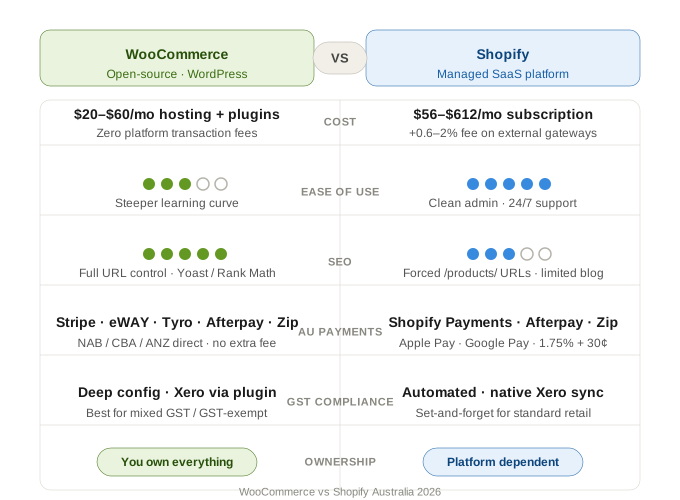
Shopify’s three main plans run approximately $56, $153, and $612 per month in AUD and GST applies on top of all of that. The Basic plan gets you two staff accounts and basic reporting. The mid-tier Shopify plan covers five staff accounts with standard reports. Advanced, at over $600/month, unlocks 15 accounts and detailed analytics. Those prices are workable, but the real sting comes from transaction fees. If you use any payment gateway other than Shopify Payments, PayPal, Afterpay standalone, eWAY, Shopify charges an additional platform fee ranging from 2% on Basic down to 0.6% on Advanced. On $500,000 annual revenue using PayPal on the Basic plan, that’s $10,000 per year disappearing before you’ve paid a single operating expense.
WooCommerce itself costs nothing. What you actually pay is Australian hosting ($20–$60/month for a quality local server), a premium theme if you want something polished ($80–$300 once-off), and a handful of plugins for shipping, SEO, and cart recovery ($200–$800/year combined). A developer to set it up properly might cost $1,500–$5,000 up front. After that, there are no platform transaction fees, you pay only your payment gateway’s standard processing rate, the same rate Shopify users pay plus Shopify’s cut on top.
For low-volume stores under roughly $100,000 annual revenue, Shopify’s predictable monthly fee is easier to budget for. As volume climbs, WooCommerce’s zero transaction fee structure compounds into substantial savings. A $1M/year store on Shopify Basic routing payments through PayPal is handing $20,000 annually to Shopify for the privilege. WooCommerce does not charge that.
GST Compliance: Both Work, With Differences
Australian businesses must correctly calculate and collect 10% GST at checkout and report it accurately to the ATO. Both platforms handle the basics, but their approach differs.
Shopify automates GST setup through Settings > Taxes. It integrates directly with Xero and MYOB, and for most standard retail businesses the configuration is genuinely set-and-forget. The limitation is that Shopify’s tax reporting is thin on lower-tier plans. You’ll likely need a Xero integration to produce reports your accountant can actually use at BAS time.
WooCommerce handles GST natively and gives you deeper configuration control — a meaningful advantage if your business sells a mix of GST-applicable and GST-exempt products, which is common in food, medical supply, and education. WooCommerce’s Xero integration is well-supported through plugins. Edge cases require either developer time or careful plugin selection, but the flexibility is there when you need it.
For standard retail with straightforward tax situations, both platforms are adequate. If your GST position is complex, WooCommerce gives you more room to configure it correctly.
Australian Payment Gateways and BNPL
Australian shoppers have specific payment expectations, and buy now pay later (BNPL) penetration here is among the highest in the world. Getting payment options wrong has a direct impact on your conversion rate.
Shopify Payments, powered by Stripe under the hood, is the cleanest path on Shopify. It supports Afterpay and Zip natively, along with Apple Pay, Google Pay, and standard credit and debit cards in AUD. Stick with Shopify Payments and you pay 1.75% plus 30 cents per domestic transaction with no extra platform layer. Switch to any external gateway and the platform fee applies. The practical advice for Shopify merchants: use Shopify Payments unless you have a compelling reason not to.
WooCommerce supports a broader range of gateways without any additional penalty. WooPayments is the native option (Stripe-powered), but you can also run Stripe directly, PayPal, Afterpay, Zip, eWAY, and Tyro — and WooCommerce has direct integrations with Australian bank merchant facilities through NAB, CBA, Westpac, and ANZ. If your business needs a direct bank merchant facility rather than a Stripe-routed payment, WooCommerce is the only viable option between the two platforms.
Both support Afterpay and Zip. If BNPL is a non-negotiable for your customer base — and in most Australian retail categories it should be considered one — neither platform blocks you.
SEO: WooCommerce Has a Structural Advantage
This is where the comparison tilts decisively for content-led businesses.
WooCommerce runs on WordPress, the most SEO-capable CMS available. Paired with Yoast SEO or Rank Math, you get granular control over schema markup, URL structures, canonical tags, Core Web Vitals performance, and content marketing without artificial limitations. There is no ceiling on how much content you can publish, how you structure your information architecture, or how deeply you can optimise individual pages. If organic search is your primary acquisition channel — which is common for niche retailers, professional services, and businesses in competitive categories — WooCommerce’s SEO potential is substantially higher than Shopify’s.
Shopify has improved considerably in recent years, but it retains structural limitations that matter at a serious SEO level. URL structures force /collections/ and /products/ prefixes that cannot be removed, which limits how you organise your site architecture. Blogging exists but is not a platform strength. Shopify’s SEO is sufficient for most merchants who are not deeply invested in organic search — but it will not outperform a well-configured WooCommerce store targeting the same keywords in the same market.
If you are building a content-driven brand in Australia and organic search is central to how you acquire customers, WooCommerce is the stronger platform. That is not a marginal difference — over two to three years, it compounds significantly.
Read More:How AI is Transforming Custom Ecommerce Website Development
Final Verdict
The platform migration you want to avoid is the one you do in three years because you made the wrong choice today. Shopify is faster to launch, easier to manage, and the right fit for most straightforward retail businesses. WooCommerce is more powerful, more cost-effective at meaningful revenue, and the stronger long-term platform for SEO-led brands.
Be honest about your technical capacity, your acquisition strategy, and your five-year revenue ambitions. For most Australian small businesses going live for the first time in 2026, Shopify removes enough friction to justify the cost. For established businesses with SEO investment or approaching revenue thresholds where transaction fees bite, WooCommerce delivers more long-term value and—critically—more control over the digital asset you’re building through professional Ecommerce Website Design & Development Services.