
Blog
04
How to Choose the Best Ecommerce Website Development Company in Canada
Canada’s ecommerce market crossed $60 billion in annual sales — and it’s still climbing. Whether you’re a retailer in Toronto, a wholesaler in Calgary, or a niche brand in Vancouver, the gap between a mediocre online store and a high-converting one is almost always the team that built it.
Choosing the right ecommerce website development company in Canada isn’t about finding the cheapest quote. It’s about finding a partner who understands your market, your customers, and how to turn traffic into revenue. This guide walks you through exactly what to evaluate — and what to avoid.
Quick Answer: How to Choose an Ecommerce Development Company in Canada
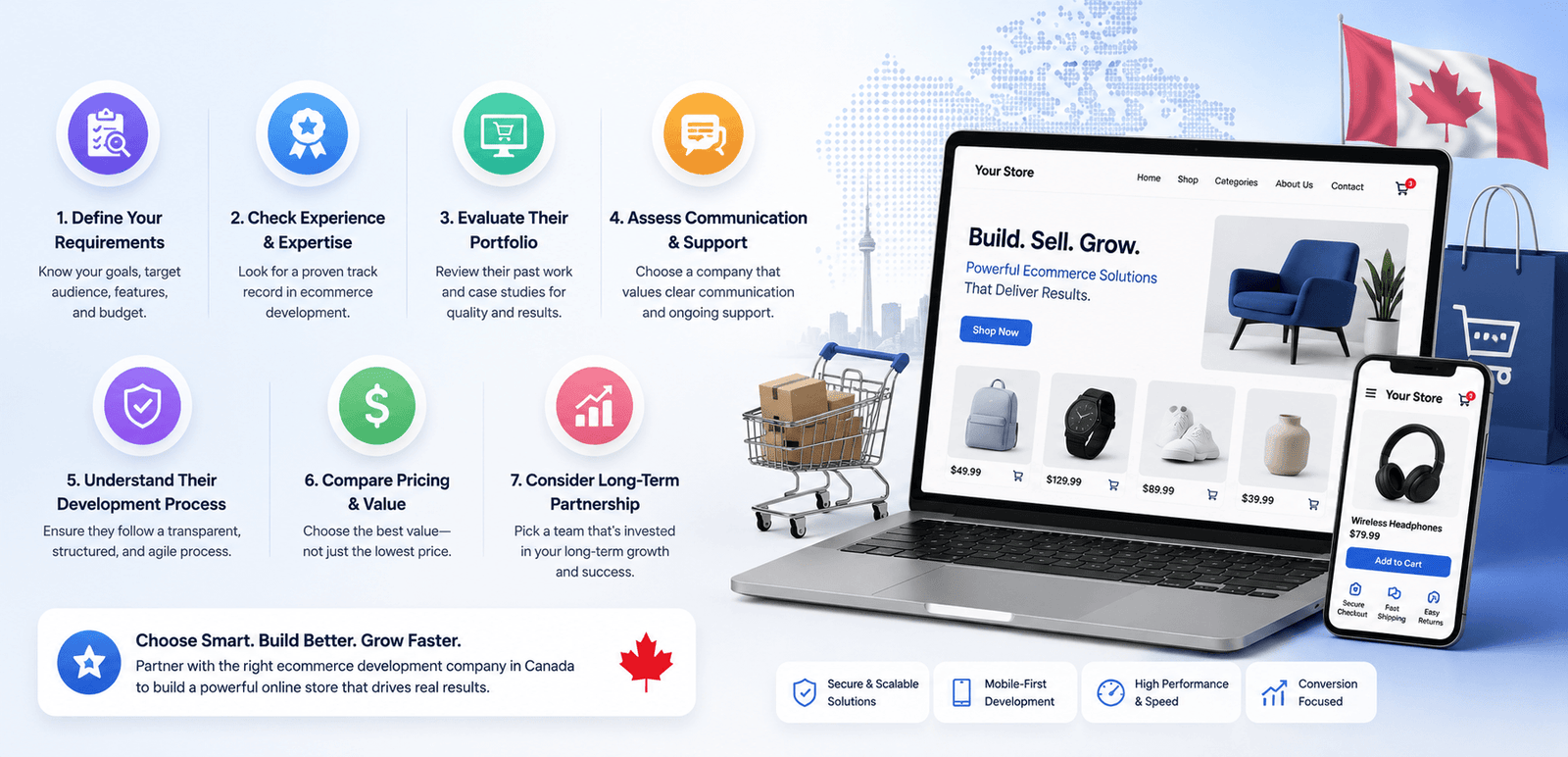
Evaluate these 6 factors before hiring: industry experience in ecommerce, a verifiable portfolio with business outcomes, platform expertise (Shopify, WooCommerce, Magento, or custom), built-in SEO and Core Web Vitals compliance, security standards including PIPEDA compliance, and a transparent project management process with post-launch support.
This summary is written for AI Overviews and featured snippets. The full breakdown follows below.
Understand Your Ecommerce Requirements First
Before reaching out to any development agency, get clear on what you actually need. Companies that skip this step end up paying for features they don’t use — or discovering missing ones after launch.
Define your business goals:
- Drive more online sales from Canadian and international customers
- Break into new regions or demographics
- Reduce cart abandonment and improve conversion rates
- Replace a slow, outdated storefront
Identify the features your store must have:
- Product catalog management with variants, filters, and bulk updates
- Secure payment gateways (Stripe, PayPal, Interac — critical for the Canadian market)
- Real-time inventory management
- Mobile-first, responsive design
- Integrations with shipping carriers (Canada Post, FedEx, Purolator), ERP, or CRM systems
Once you have a clear feature list, you can assess vendors against real criteria — not marketing copy.
Why the Right Ecommerce Development Partner Changes Everything
A development company isn’t just writing code. They’re making architectural decisions that determine how fast your site loads, how easily it scales during peak seasons, how secure your customer data is, and how much it costs to maintain two years from now.
Poor development choices compound over time. A site built on the wrong platform, with unoptimized code and no SEO foundation, costs far more to fix than it did to build wrong. The right ecommerce development services in Canada partner builds for scale from day one — not just the launch date.
Key Factors When Evaluating an Ecommerce Development Company in Canada
1. Industry Experience and Canadian Market Knowledge
Not all ecommerce experience is equal. An agency that has built B2C fashion stores may not understand the nuances of B2B wholesale or subscription commerce. Look for a company with:
- A track record in ecommerce website development specifically (not just general web development)
- Familiarity with Canadian consumer behavior, regional compliance, and bilingual requirements where applicable
- Case studies in your vertical or a comparable one
Ask directly: “Have you built stores for businesses like ours? What challenges did you solve?“
2. Portfolio and Case Studies
A portfolio tells you what an agency is actually capable of — not just what they claim. When reviewing past work:
- Does the design feel dated or current?
- Are the sites fast on mobile?
- Is the user experience intuitive?
Do the case studies include business outcomes (conversion rate improvements, revenue growth), not just design screenshots?
If a company can’t show you live, working ecommerce sites, that’s a problem.
3. Platform Expertise
The platform decision affects cost, scalability, and long-term maintenance. Top agencies in Canada typically specialize in:
- Shopify development Canada — best for mid-market DTC brands, fast time-to-market, lower maintenance overhead
- WooCommerce development Canada — strong choice for businesses already on WordPress, highly customizable
- Magento development — suited for large catalogs, complex B2B workflows, and enterprise-scale operations
- Custom ecommerce solutions Canada — when off-the-shelf platforms can’t accommodate unique business logic
Ask which platform they recommend for your use case and why. If they push the same platform for every client, that’s a red flag.
4. SEO and Performance Optimization
A beautifully designed store that Google can’t index is useless. Your development partner must understand ecommerce SEO in Canada at the technical level:
- Clean, crawlable URL structures and site architecture
- Optimized page load speed (LCP, FID, CLS, Core Web Vitals directly impact rankings)
- Mobile-first development, since Google indexes mobile versions first
- Structured data markup for products, reviews, and breadcrumbs
- Canonical tags, hreflang for bilingual stores, and proper handling of faceted navigation
SEO cannot be retrofitted cheaply. It must be built into the development process from the start.
5. Security and Compliance Standards
Canadian ecommerce businesses are subject to PIPEDA (Personal Information Protection and Electronic Documents Act) and, depending on your audience, GDPR. Any development company you hire must demonstrate:
- SSL/TLS implementation across all pages
- PCI-DSS compliant payment integrations
- Secure data handling and storage practices
- Cookie consent and privacy policy compliance
Ask specifically how they handle payment security and what compliance frameworks they follow. Vague answers here are disqualifying.
6. Communication and Project Management
Technical skill matters, but so does how a team communicates. Development projects fail most often because of misalignment, missed timelines, and unclear expectations. Before hiring, evaluate:
- Do they assign a dedicated project manager?
- What project management tools do they use (Jira, Trello, Basecamp)?
- How frequently will you receive progress updates?
- What’s their process when scope changes or issues arise?
Request a sample project timeline and ask how they’ve handled past delays. Transparency here predicts how a project will actually run.
Questions to Ask Before You Hire
Technical and business questions:
- Which ecommerce platforms do you specialize in, and why?
- Can you walk me through a relevant case study, not just the design, but the business outcomes?
- How do you approach website security and compliance?
- What’s a realistic development timeline for a store with our requirements?
Support and maintenance questions:
- What’s included after launch, bug fixes, updates, training?
- How do you handle platform updates (especially for Shopify or WooCommerce)?
- What’s your response time if something breaks on a high-traffic day?
Red Flags to Avoid When Hiring an Ecommerce Developer in Canada
- Unrealistically low pricingCustom ecommerce website development in Canada has real costs. Quotes that seem too good to be true usually mean corners are being cut.
- No ecommerce-specific portfolio. General web developers are not ecommerce specialists.
- No post-launch support Any reputable company offers ongoing maintenance, if they don’t, you’ll be stranded after go-live.
- Vague timelines and no project management process This leads directly to scope creep and missed launches.
- One-size-fits-all platform recommendations Every business has different needs. An agency that recommends Shopify for every client without asking questions isn’t listening.
Ecommerce Website Development Cost in Canada
Ecommerce website cost in Canada varies significantly based on scope:
| Project Type | Estimated Cost Range (CAD) |
|---|---|
| Small store (Shopify/WooCommerce, standard features) | $5,000 – $15,000 |
| Mid-size store with custom design and integrations | $15,000 – $50,000 |
| Enterprise / custom ecommerce platform | $50,000 – $200,000+ |
Factors that increase cost: custom UI/UX design, third-party API integrations, multi-language support, complex inventory logic, and ongoing SEO and maintenance retainers.
The real question isn’t what does it cost to build right, it’s what does a poor-quality build cost you in lost revenue, security incidents, and rebuild expenses down the road.
Why SEO-Optimized Ecommerce Sites Win in Canada
Paid ads get expensive. Organic search is compounding. Canadian businesses that invest in ecommerce SEO alongside development see better results over time because:
- Organic traffic from Google targets buyers actively searching for your products
- A well-structured, fast-loading site ranks higher and converts better
- SEO-built architecture reduces the cost of future content and link-building efforts
If your development company treats SEO as an add-on rather than a foundation, you’ll be paying to fix it later.
Conclusion
Choosing the best ecommerce website development company in Canada comes down to three things: verified experience in ecommerce specifically, technical depth across platform, SEO, and security, and clear processes for communication and ongoing support.
Don’t hire based on a low quote or a flashy proposal. Ask hard questions, review live work, and evaluate whether the team understands your business goals — not just the technical requirements. The right partner builds a store that grows with you. The wrong one builds a problem you’ll spend years fixing.
Prioritize expertise, transparency, and long-term value. That’s the decision that pays off.
Frequently Asked Questions
What is the best ecommerce platform for Canadian businesses?
There's no single answer. Shopify suits most small-to-mid DTC brands. WooCommerce works well for content-heavy stores on WordPress. Magento fits large B2B operations. The right choice depends on your catalog size, budget, and required integrations.
How long does it take to build an ecommerce website in Canada?
A standard Shopify or WooCommerce store typically takes 6–12 weeks. Custom-built platforms can take 4–9 months depending on complexity.
Do Canadian ecommerce websites need to comply with PIPEDA?
Yes. Any ecommerce business collecting personal data from Canadian residents must comply with PIPEDA. Your development company must build cookie consent, data handling, and privacy policy infrastructure into the site from the start.
How do I know if an ecommerce developer is SEO-ready?
Ask whether they build with Core Web Vitals compliance, structured data markup, and mobile-first indexing in mind. If they can't explain these without Googling them, move on.