
Blog
17
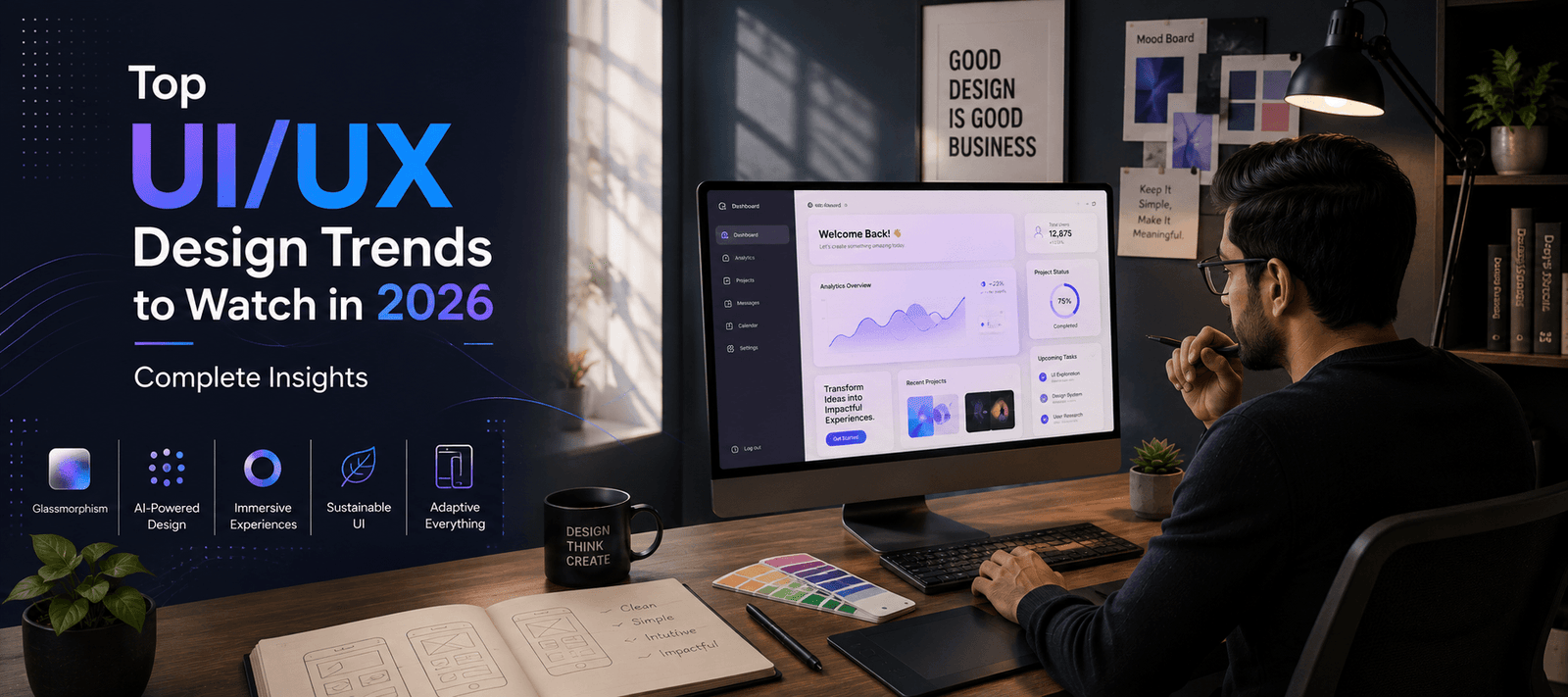
Top UI/UX Design Trends to Watch in 2026 – Complete Insights
Can you recall any website or application which was really user-friendly? Most probably, you found everything that you wanted to find immediately, knew what to click on and did not spend a lot of time finding your way around it. Such is the direction of UI UX design trends 2026 are taking.
Intelligent, personalized, accessible and user-focused experiences will be defining the future of UI/UX design. Using artificial intelligence will assist designers in understanding how people use websites and develop an experience based on that, whereas users want fast, responsive and easy-to-use interfaces.
According to Statista, mobile devices (without tablets) accounted for 51.48% of total website traffic worldwide in Q2 2026.
Australian companies should take into account such tendencies and offer improved digital customer experience.
Let us look at the trends driving UI/UX and how businesses can use them wisely.
Importance of UI/UX Design for Australian Businesses in 2026
Even a quality product will fail to attract users due to a poorly designed website. Such factors as confusing menus, slow loading, or difficult checkout process can drive users away quickly.
High-quality UI/UX simplifies the experience of users. It allows them to easily locate information, perform actions and become more comfortable. Another essential element is mobile-first design because users require websites to work on mobile devices.
There is also the aspect of accessibility. The proper typography, colors, easy-to-use navigation, and forms will help to create more accessible digital products. That is why UI UX design trends 2026 Australia are associated with usability and accessibility.
Top UI/UX Design Trends in 2026
- AI-Powered UI/UX Design
- Adaptive & Personalised User Interfaces
- Generative UI and AI-Driven Interfaces
- Accessibility-First & Inclusive Design
- Multimodal User Experiences
- Micro-Interactions & Motion Design
- Minimalist but More Functional Interfaces
- Design Systems & Component-Based UI
- Mobile-First and Responsive UX
- Spatial and Immersive UX
AI will help design teams in analysing user behaviour, laying out designs, organising research, and performing repetitive tasks. AI can be helpful in creating a personal experience of users based on their behaviour patterns.
All of the mentioned AI UX design trends 2026 will make the design work more effective and fast. Nevertheless, AI should support humans, not replace them in the design process. Human intervention and judgement are needed for user needs analysis and strategy formulation.
Each user has his or her purpose. A first-time visitor wants to find basic information while a returning customer wants to access orders he/she previously made.
Adaptive interfaces can be responsive to user needs and modify recommendations, content, dashboards, and navigation. These adaptive interfaces will be especially useful for ecommerce and service websites, where users’ purposes will be fulfilled faster.
Generative UI allows different elements of an interface to adapt to users’ needs. The generative UI doesn’t offer the same interface screen to all users but adapts it depending on requests made.
In the process of communication with an AI assistant, customers can ask about particular things, and the assistant will show them relevant options. The process will be useful in customer support, bookings, ecommerce, etc.
Accessibility needs to become one of the primary principles of design, rather than being an additional one. Designers need to pay attention to readable text, color contrasts, keyboard accessibility, labeling, and forms that are easy to fill out.
The WCAG guidelines can prove useful in this respect to those groups designing experiences that will be accessible to everyone. When accessibility becomes an inherent part of the design process, it will become possible to create more usable products for people of various kinds.
Users communicate with technology with the help of text, voice, touch, visuals and gestures. Multimodal UX combines these channels in order to make digital experience better for users.
For instance, users may use the voice channel instead of browsing several webpages. Moreover, conversational UX may simplify some processes for the user. The most important thing here is to apply each interaction channel only in those cases where it actually benefits the user.
Even small animations can make the interface responsive. For instance, designers may add animations that show when users click on buttons or indicate that some process is running (loading animation).
All such micro-interactions provide meaningful feedback for the users but must not become distractive. Too many animations affect the site’s performance negatively and make it uncomfortable for the user. Motion design must remain discreet and support the user’s action.
Modern minimalism does not imply the absence of any visual elements on the page. It means that all distracting elements must be removed while important ones are kept.
Navigation tools, hierarchy of content, white spaces and legible typography enable users to understand information quickly. Minimalism means simplicity but not the absence of functional elements or hiding basic actions.
Design systems consist of reusable components, colors, typography, and interaction patterns. With the help of design systems, teams manage to be consistent across various pages and products.
Teams do not have to invent buttons or forms; there are already ready-made components. In addition to saving time, this approach makes further updates simpler. For a growing startup, a design system serves as an additional layer of reliability for building digital products.
An outstanding website on a laptop may become uncomfortable to use on a mobile device. Mobile-first UX starts with small devices taking into account touch, readability, performance, and simplicity of navigation right away.
Then responsive layout helps adapt the experience for all devices: from mobile phones to tablets and laptops. It is equally important to ensure fast loading and simple interactions as well as aesthetic appearance of the interface.
Spatial UX relies on technologies like AR, VR, and 3D and provides a more immersive experience. However, spatial technologies are not necessary for every company.
They might be useful when they solve some problems for the customer. A furniture company might allow its customers to visualize their products in their homes while a real estate company could provide virtual tours through properties.
Read More: How to Choose a Graphic Design Company in Ahmedabad
AI and the Future of UI/UX Design
Artificial Intelligence will be useful in research, prototyping, testing, personalization, and analysis of user feedback. In other words, it will allow designers to detect patterns faster and try various solutions before developing the product.
Another area in which AI can contribute to the future of UI/UX design is Predictive UX. It allows using behavior patterns to predict what a user may need next and make this option easily accessible.
It does not mean that human designers become redundant. They still need empathy, creative thinking, knowledge of context and strategy to know what people really need. That is why collaboration of AI and human designers will be the most important part of the “emerging UX design trends 2026”.
Implementation of These UI/UX Trends Without Overdesigning
Including every new trend makes websites too complicated. One should start from the research about his/her customers and define the most significant problem.
Choosing the solution of this problem as a trend, one should build a prototype, test it, measure results and improve it. For instance, if customers have problems with finding products, more effective navigation can solve their problem better than any AI chatbot. In this case, the main idea of the latest UI UX design trends Australia should be usability, not trendiness.
Common UI/UX Mistakes to Avoid in 2026
Companies can create poor experience by following UI/UX trends without caring about their users. The most common mistakes are the following ones:
- Excessive animation
- Ignoring accessibility
- Design for desktop devices only
- Artificial Intelligence without any reason
Poor performance, confusing navigation, inconsistency of design elements, focusing on aesthetics rather than usability are other issues that can spoil the user experience.
One question should be asked before including any feature into UI/UX: Does this feature make the user’s task easier?
How to Choose the Right UI/UX Trends for Your Business
Businesses do not have to incorporate all UI/UX trends. The correct choice depends on business goals, users’ needs, and problems being solved.
It is recommended to follow this framework:
Business goal → User need → Trend → Prototype → Test → Measure → Improve
For instance, an ecommerce business might profit from personalised recommendations, while a service business might require conversational assistance.
Such approach will allow businesses to select appropriate UI UX design trends for Australian businesses based on needs, rather than following competitors blindly.
Future of UI/UX Design in Australia
The future of UI UX design in Australia will probably be centered on more intelligent, personal, accessible, and trustworthy interfaces.
AI-powered interfaces, conversational UX, and multimodal interactions might gain more attention. In addition, the importance of accessibility will likely increase in the future.
Privacy, performance, and trustworthiness will still remain important factors. Businesses which manage to find the balance between innovations and simplicity can form better relationships with their customers.
Read More: How to Choose the Right Digital Marketing Agency in Sydney
Conclusion
Not all UI UX design trends 2026 are focused on creating futuristic interfaces. The most valuable trends include AI, personalisation, accessibility, mobile-first approach, motion, design systems, and immersive experiences.
Australian businesses should not try to implement all trends at once. They should start with getting to know their users and identifying major pain-points in order to understand which trends will really help.
With the proper UI/UX design strategy, businesses will be able to create valuable digital experiences out of innovative ideas.
Businesses looking for professional UI/UX design support can work with an experienced design team to turn these ideas into practical digital experiences.