
Blog
16
AI Website Development in Melbourne: What It Actually Means for Your Business in 2026
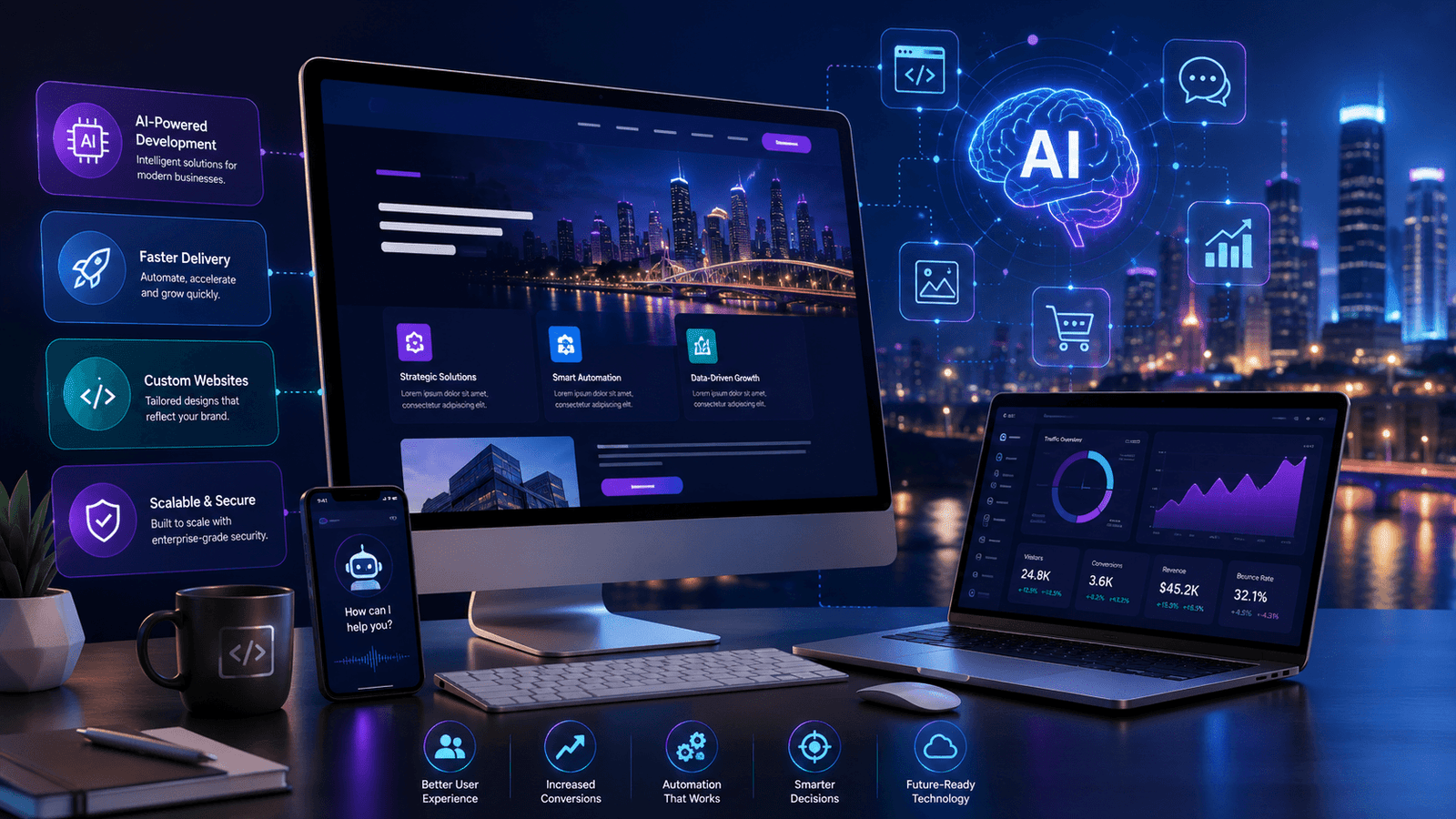
A few years ago, building a website meant weeks of back-and-forth with a designer, a developer, and usually a copywriter. Now you can describe your business to a piece of software and have a working draft on screen before your coffee goes cold. That shift is what people mean when they talk about AI website development, and for Melbourne businesses trying to get online without draining the budget, it has changed the maths considerably.
It has also created a fair bit of confusion. Everyone has an opinion, half the tools promise miracles, and it is hard to tell where AI genuinely helps and where it quietly makes things worse. So here is an honest walkthrough of what website development AI can and cannot do in 2026, and how to decide what is right for you.
So what is AI website development, really?
At its simplest, AI website development means using artificial intelligence to do the heavy lifting on a website: generating page layouts, drafting copy, producing images, writing and fixing code, and tidying up the technical details that help a site load fast and show up in search.
There are two flavours of it. The first is the all-in-one builders like Wix, Squarespace, Framer and Hostinger, where you answer a few questions and the platform assembles a whole site for you. The second is the developer’s toolkit, where AI assistants like GitHub Copilot or Cursor sit alongside a coder and help them build custom work far more quickly. Most serious projects these days use a bit of both, which is really the point:
AI for website development is less a single product and more a set of shortcuts running through the whole process.
Why so many Melbourne businesses have made the switch
The appeal is not complicated. Melbourne is a competitive city for almost every trade, from hospitality to professional services, and a decent website is now table stakes rather than a nice-to-have. What has changed is that you no longer need a big budget to get one.
The adoption numbers back this up. Roughly 58% of small businesses now use generative AI in some form, more than double the figure from 2023 (Hostinger, 2026). Draft-a-whole-site timelines have collapsed too. What used to take a working week can now be produced in around fifteen minutes (Hostinger, 2026). And it is small and medium businesses, not big corporates, driving most of this; SMEs account for close to half of all spending on AI website builders (Precedence Research, 2026).
For a café owner, an electrician, or a small legal practice, that means a credible site can be live in days, with money left over for the things that actually bring customers in.
Read More: Custom vs Template Website: Which is Better?
Where AI helps, step by step
It is worth being specific about what the technology is good at, because the marketing tends to blur it.
On design, AI is genuinely strong. Describe your brand and it will produce full page layouts, colour choices, and a mobile-friendly structure in seconds. On writing, it is useful for a first draft of headlines, service pages and product blurbs, though the output almost always needs a human to fix the tone and check the facts. On the coding side, the gains are real and measurable: in controlled tests, developers finished tasks up to 55% faster with AI assistance (Rudys.AI, 2026). And on the technical SEO front, AI tools now handle a lot of the fiddly work automatically, writing meta tags, structuring content, and adding the schema markup that helps search engines understand a page.
If there is one honest takeaway, it is this: AI speeds things up, but it does not run the show. The strategy, the brand voice, the judgement about what belongs on the page, and anything going live to real customers still needs a person. The best results in 2026 come from treating AI as a very fast assistant, not a replacement.
The AI tools for website development worth knowing
People often ask for the best AI tool for website development, but there is no single winner. It depends entirely on what you are trying to build.
If you want a straightforward business site up quickly with no coding, the builders are your friends. Wix’s AI generator can spin up a full multi-page site with copy and images in about ninety seconds, and businesses that used it saw noticeably better early retention than those who built by hand. Squarespace’s Blueprint AI takes you through a short brand questionnaire and produces layouts aimed squarely at conversions; it was good enough to land on TIME’s Best Inventions list in 2025. Hostinger’s builder has passed a million users, most of whom had never made a website before.
If you care more about design polish and control, Framer and Webflow give you AI help without taking the wheel entirely. And if you are building something genuinely custom, whether that is integrations, unusual functionality or a platform that needs to scale, that is developer territory, where Copilot and Cursor do their best work in the hands of someone who knows how to code.
The simple rule: reach for a builder if your site is fairly standard, and bring in a developer or agency using AI tools if it is not.
AI-built sites versus the traditional route
The trade-off comes down to speed and cost against control and complexity. An AI-powered build gives you a first draft in minutes and a lower starting price, and for a standard business website that is often all you need. A traditional custom build costs more and takes longer, but you get exactly what you want, which matters when the site is complex or has to handle serious growth.
In practice most Melbourne agencies no longer treat this as an either-or. They let AI handle the repetitive two-thirds of the job and put their people on the parts that make a difference: strategy, brand, and the details AI reliably gets wrong. It is faster than the old way and better than pure automation, which is why the hybrid approach has quietly become the norm.
Will an AI-built website actually rank?
Yes, if you do it properly. AI-generated sites can compete perfectly well in search because the tools take care of the optimised copy, tags, and structured data. What they cannot do is manufacture genuine quality or authority. That still comes down to useful content, a fast site, and a sensible SEO plan.
One thing has shifted, though, and it is worth paying attention to. Search is no longer just Google’s ten blue links; people increasingly get answers straight from AI tools. More than half of marketing leaders say optimising for AI-driven search is a priority this year (Webflow, 2026), and sites built to be read by these systems are seeing the payoff. One study found AI-crawled pages pulled in over 300% more human traffic than those that were not (Duda, 2026). The practical fix is unglamorous: clear headings, direct answers, a proper FAQ, and clean structure so both Google and the AI engines can understand you.
Read More:10 Signs Your Website Needs a Redesign in 2026
The short version
AI website development is no longer experimental. It is just how most sites get made now, including here in Melbourne. Used well, it means launching faster, spending less, and ending up with something that gets found in both regular and AI-powered search. The trick is knowing where the software helps and where a human still needs to step in.
If you are planning a new website or considering a redesign, partner with a team that combines the speed of AI with the expertise of experienced developers. Wedoodles Infotech uses advanced AI website development tools to accelerate delivery while ensuring every website is strategically designed, SEO-friendly, and built for long-term business growth. That balance is what separates a website that merely exists from one that actually earns its keep.
Ready to build a smarter, AI-powered website? Contact Wedoodles Infotech today and discover how we can help your Melbourne business grow online.
Frequently Asked Questions
What is AI website development?
AI website development uses artificial intelligence to assist with website design, content creation, coding, SEO optimization, and user experience improvements. It helps businesses launch websites faster and more cost-effectively than traditional development methods.
Is AI website development suitable for small businesses in Melbourne?
Yes. AI-powered website builders and development tools make it easier for Melbourne SMEs to create professional websites without the high costs and long timelines typically associated with custom development.
Can AI build a complete website without human involvement?
AI can generate layouts, content, images, and even code, but human expertise is still important for strategy, branding, quality control, SEO planning, and ensuring the website meets business goals.
Which AI tools are commonly used for website development in 2026?
Popular AI website development tools include Wix AI, Squarespace Blueprint AI, Hostinger AI Website Builder, Framer AI, Webflow AI, GitHub Copilot, and Cursor for custom development projects.
Are AI-generated websites good for SEO?
Yes. Most AI website development platforms help with SEO by creating meta tags, structured content, schema markup, and mobile-friendly designs. However, long-term rankings still depend on high-quality content, site performance, and ongoing SEO efforts.
How much does AI website development cost compared to traditional development?
AI website development is generally more affordable because it reduces design and development time. Simple business websites can be created at a fraction of the cost of a fully custom-built website, while complex projects may still require professional developers.
Should I choose an AI website builder or hire a web development agency?
If you need a basic business website, an AI website builder may be sufficient. For custom functionality, advanced integrations, scalability, and a stronger digital strategy, partnering with an experienced Melbourne web development agency is usually the better option.